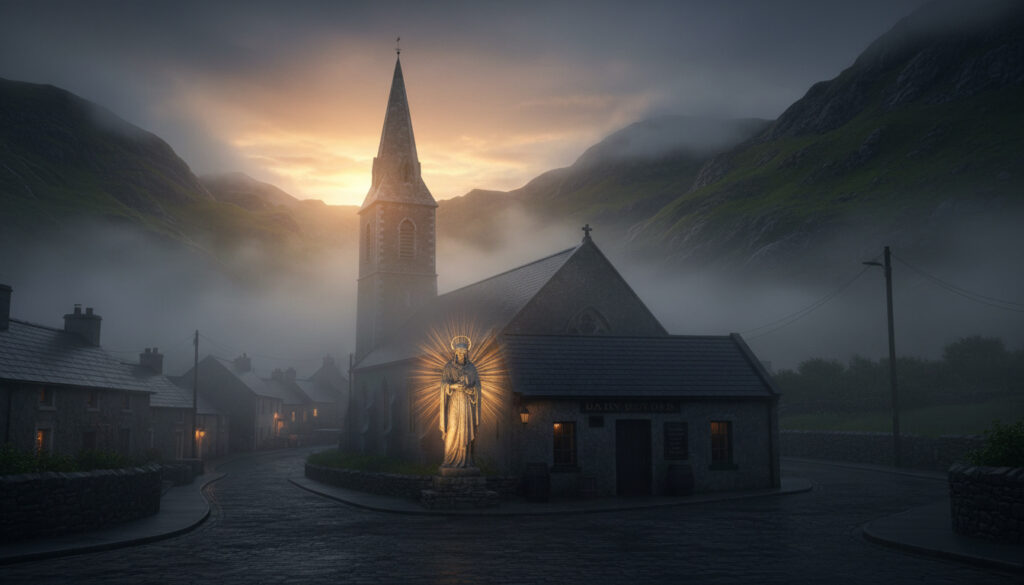
In the Land of Saints and Sinners – Plot, Cast, Reviews Guide
In the Land of Saints and Sinners transports Liam Neeson to 1974 rural Ireland, where he plays Finbar Murphy, a retired assassin drawn back into violence when IRA terrorists seek refuge in his coastal village. The film blends the moral weight of the Western genre with the specific historical tensions of the Troubles, creating a thriller that relies as much on atmospheric dread as on explosive action.
Directed by Robert Lorenz, the movie positions Neeson not as the invincible force of his later action career, but as a man contemplating mortality after the death of his wife. When a botched bombing in Belfast forces four IRA operatives to hide in Glencolmcille, County Donegal, Murphy’s forced retirement crumbles under the weight of local brutality and personal obligation.
The production emphasizes authenticity, filmed on location in Donegal to capture the period’s isolation and unease. With a runtime of 106 minutes, the narrative maintains economical pacing while exploring themes of redemption, violence, and moral reckoning in a divided Ireland.
What is In the Land of Saints and Sinners About?
The narrative opens in Belfast, 1974, where IRA member Doireann McDonnell leads a squad including her brother Curtis and associates Conan and Séamus in a pub bombing that inadvertently kills children. Fleeing the city, they relocate to the remote village of Glencolmcille, County Donegal, near the Northern Ireland border.
Finbar Murphy has established a quiet life as a bookseller after retiring from contract killing for local crime boss Robert McCoy. His withdrawal from violence stems from a target’s dying plea, which prompted reflection on his own mortality following his wife Margaret’s death. When Curtis assaults Moya, the teenage daughter of pub owner Sinéad, Murphy breaks his oath of non-involvement, recruiting Kevin—Robert’s unstable new assassin—to eliminate Curtis.
This intervention triggers Doireann’s hunt for Murphy, escalating into a siege that tests Murphy’s code of ethics against the practical necessities of protecting his community.
- Historical Anchor: The film uses the 1974 Troubles timeline to ground its fiction in documented political violence.
- Moral Complexity: Murphy’s character rejects the “retired killer with particular skills” trope in favor of genuine hesitation and spiritual questioning.
- Local Crime Nexus: The intersection of IRA politics and village-level criminal enterprise creates multiple layers of threat.
- Authentic Location: Filming in Glencolmcille provides geographical specificity rarely seen in Irish-set thrillers.
- Ensemble Cast: Strong supporting performances, particularly from Kerry Condon as Doireann, elevate beyond standard genre expectations.
- Economical Storytelling: The 106-minute runtime focuses on essential plot mechanics without excessive exposition.
- Western Homage: The lone gunslinger protecting a town from outlaws translates effectively to the Irish landscape.
| Fact | Details |
|---|---|
| Director | Robert Lorenz |
| Writers | Mark Michael McNally, Terry Loane |
| Setting | Glencolmcille, County Donegal, 1974 |
| Lead Actor | Liam Neeson (Finbar Murphy) |
| Antagonist | Kerry Condon (Doireann) |
| Crime Boss | Colm Meaney (Robert) |
| Runtime | 106 minutes |
| Release (US) | August 2024 |
| Genre Classification | Irish Western / Action |
| Historical Period | The Troubles |
Who Stars in In the Land of Saints and Sinners?
The cast combines veteran Irish actors with emerging talent, creating a textured portrayal of a community under siege. Liam Neeson anchors the film as Finbar Murphy, delivering a performance that critics noted ranks among his more nuanced recent action roles.
Kerry Condon portrays Doireann, the IRA operative whose fanaticism masks a complex relationship with her brother Curtis. Colm Meaney appears as Robert, the local crime boss who relies on Murphy’s particular skills but respects his retirement. Jack Gleeson—recognizable from Game of Thrones—plays Kevin, whose instability introduces unpredictable violence into Murphy’s calculated plans.
Who Directed In the Land of Saints and Sinners?
Robert Lorenz directed the feature, marking another collaboration in his career associated with Clint Eastwood’s production stable. Lorenz emphasizes classical storytelling structures, focusing on character motivation and spatial geography rather than rapid editing. His direction highlights the 1970s Donegal authenticity, using the landscape as both sanctuary and trap.
Lorenz collaborated with writers Mark Michael McNally and Terry Loane to ensure the script reflected actual Donegal locations and period-appropriate details rather than generic Irish stereotypes.
Where Can I Watch In the Land of Saints and Sinners?
The film premiered in Europe in June 2023 before securing a theatrical release in the United States in August 2024. Wikipedia confirms the 2023 European debut, while regional US outlets tracked the August 2024 American rollout.
Streaming availability remains unspecified in current documentation. The film has not been confirmed for major subscription platforms such as Netflix, though distribution patterns suggest eventual digital release following the theatrical window.
No specific streaming platforms or digital rental services have been officially announced for post-theatrical distribution as of the latest reports.
What Are the Reviews for In the Land of Saints and Sinners?
Critical reception positions the film as “well-written and classically constructed,” distinguishing it from Neeson’s more generic action vehicles of recent years. Rotten Tomatoes aggregates positive notices highlighting the economical pacing and period authenticity.
Analysis from Hollywood Progressive notes the film’s exploration of Troubles violence and redemption themes, though some critics questioned the rapidity of Finbar’s moral conversion from hitman to protector. The Never Felt Better review praised the 1970s Donegal setting while noting the simplicity of the protagonist’s redemption arc.
What Is the Ending of In the Land of Saints and Sinners?
Spoiler warning: The following reveals plot details from the final act.
The climax occurs in Sinéad’s pub, where Kevin reveals he killed Curtis, sparking a shootout with Doireann’s remaining IRA associates. Simultaneously, Séamus detonates a bomb outside, killing himself and destabilizing the building. Finbar eliminates Conan during the melee, while Kevin and Garda Vinnie perish in the crossfire.
Wounded, Doireann flees to a nearby church where Finbar confronts her. She accepts her fate, stating, “I’ve done what I’ve done… The Lord knows.” Finbar responds, “We’ve all got our reasons,” before shooting her. The film concludes with Finbar burying Doireann alongside Curtis in his secret grove—a location previously established as his private burial ground for victims—symbolizing his adherence to a personal code of honor while acknowledging his irredeemable nature.
The burial pairing of Doireann and Curtis—siblings separated by death in Finbar’s grove—suggests his final act serves as both mercy and judgment, binding his enemies together in death as he attempts to free the living.
When Was In the Land of Saints and Sinners Produced and Released?
- : Principal photography commenced in County Donegal, Ireland, utilizing authentic village locations to establish period credibility.
- : European premiere at the Donostia Zinemaldia (San Sebastián International Film Festival) in Spain.
- : General theatrical release across European markets.
- : United States theatrical release, distributed through specialty and select mainstream cinemas.
- : Critical reviews and analysis published following US availability, including regional coverage from New Orleans-based outlets.
Is In the Land of Saints and Sinners Based on a True Story?
Established Facts
- Finbar Murphy is a fictional character; no historical record documents a specific hitman in 1974 Glencolmcille.
- The IRA bombing depicted in the opening draws from general patterns of violence during the Troubles, not a specific documented incident.
- Glencolmcille is a real village in County Donegal, but the events portrayed are fictionalized.
- The film is not connected to the television series Ballykissangel despite surface similarities in setting.
Remaining Questions
- Box office performance data has not been publicly disclosed.
- Streaming distribution windows remain unconfirmed.
- Potential sequel plans have not been addressed by the production team.
What Is the Cultural and Historical Context?
The film operates within the “Irish Western” subgenre, transplanting the lone gunslinger archetype into the contested borderlands of 1970s Northern Ireland. This setting provides inherent tension—the isolated beauty of Donegal contrasts with the imported violence of sectarian conflict.
By positioning Finbar Murphy as an independent operator rather than a political partisan, the narrative explores violence as personal choice rather than ideological necessity. The 1974 timeline places the action during a particularly volatile period of the Troubles, when bombings and reprisals had become regular features of both urban and rural landscapes.
What Do Critics Say About the Production?
“Well-written and classically constructed… one of Neeson’s better recent action thrillers with economical pacing.”
— Aggregated critical consensus, Rotten Tomatoes
“Explores Troubles violence and redemption themes, questioning Finbar’s quick shift from hitman via a victim’s speech.”
— Hollywood Progressive analysis
“Positive on 1970s Donegal authenticity but notes simplistic conversion arc.”
— Never Felt Better review
What Is the Takeaway on This Irish Thriller?
In the Land of Saints and Sinners succeeds by granting Liam Neeson a character with psychological weight beyond the standard revenge formula. Director Robert Lorenz leverages the Donegal landscape to create a Chamber Western where the constraints of 1974 Irish society—both the isolation and the ever-present political violence—generate pressure that forces moral choices. While the redemption arc may resolve too neatly for some viewers, the film’s commitment to period detail and ensemble performance distinguishes it within Neeson’s late-career action filmography. For audiences interested in the historical context or seeking Neeson’s more grounded work, the film offers substantial viewing beyond its thriller mechanics.
Frequently Asked Questions
What genre is In the Land of Saints and Sinners?
The film functions as an Irish Western, blending action-thriller elements with the moral complexity and isolated setting typical of classic American Westerns.
How long is In the Land of Saints and Sinners?
The runtime is 106 minutes, allowing for economical storytelling that maintains tension without excessive subplot development.
Where was In the Land of Saints and Sinners filmed?
Principal photography occurred in Glencolmcille, County Donegal, Ireland, utilizing authentic coastal villages to represent the 1974 setting.
Who wrote In the Land of Saints and Sinners?
Mark Michael McNally and Terry Loane wrote the screenplay, collaborating with director Robert Lorenz to develop the original story.
What happens to Finbar Murphy at the end?
Finbar survives the final confrontation, killing Doireann at the church and burying her with Curtis in his secret grove, suggesting he continues his existence as the town’s hidden protector while acknowledging his own moral darkness.
Is there a sequel planned?
No sequel has been officially announced or confirmed by the production team as of the latest available information.
More related posts
 Women’s Champions League Final 2026: How to Watch & Stream
 Sophie Raworth: Biography, Husband, Salary, and Illness
 DVLA Swansea Contact Number – Official Phone Details
 Real Betis vs Real Sociedad – Tactical Match Preview
 What Network Does Sky Mobile Use? O2 UK & Vodafone Ireland
 Justin Moorhouse: Biography, Son’s Death Rumors, Coffee Van
 Must Have Ideas UK: Ownership, Delivery & Customer Reviews
 Little Red Riding Hood – Perrault vs Grimm Origins