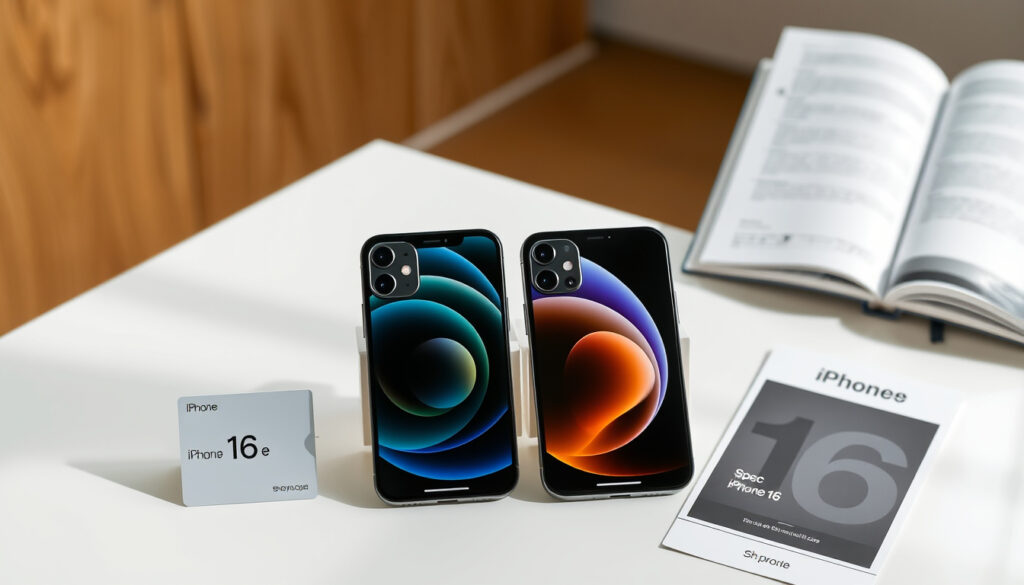
iPhone 16e vs iPhone 16: Specs, Price & Buy Guide
If you’re trying to decide between Apple’s iPhone 16 and the newer iPhone 16e, you’re probably noticing something counterintuitive: the cheaper model actually has better battery life. The iPhone 16e hit stores in September 2024 with a $599 starting price — $200 less than the iPhone 16 — yet Apple claims it delivers the best battery performance ever on a 6.1-inch iPhone. That’s worth knowing before you buy, especially given what else differs between the two.
Price Difference: $200 more for iPhone 16 · Camera Count: iPhone 16e has one less · GPU Cores: iPhone 16e has one less · Screen Brightness: iPhone 16 brighter · Battery: iPhone 16e claims best in history
Quick snapshot
- $200 separates the two models at checkout (Business Insider)
- iPhone 16e carries a single 48MP rear camera; iPhone 16 adds a 12MP ultrawide (PhoneArena)
- 16e battery capacity: 4005 mAh vs 3561 mAh for iPhone 16 (PhoneArena)
- Independent lab tests haven’t verified Apple’s 26-hour battery claim
- Case fit between the two models hasn’t been tested by users at scale
- Exact 2026-2027 software support window remains unconfirmed
- iPhone 16 released September 20, 2024 (Wikipedia)
- iPhone 16e released February 28, 2025 (Apple Newsroom)
- iPhone 16e discontinued March 2, 2026 for iPhone 17e (Wikipedia)
- Apple discontinued iPhone 16e in September 2024, replacing it with iPhone 17e
- Existing iPhone 16e units may drop in resale value
- iPhone 16 family continues as the mainstream flagship option
| Category | iPhone 16e | iPhone 16 |
|---|---|---|
| Starting Price (US) | $599 | $799 |
| Battery Capacity | 4005 mAh | 3561 mAh |
| Video Playback | Up to 26 hours | Up to 22 hours |
| Rear Cameras | 48MP Fusion (single) | 48MP Fusion + 12MP ultrawide |
| GPU Cores | 4-core | 5-core |
| MagSafe Charging | Not supported | 25W supported |
| Weight | 167g | 170g |
| Display | 6.1″ Super Retina XDR OLED | 6.1″ Super Retina XDR OLED |
| RAM | 8GB | 8GB |
| Storage Options | 128GB, 256GB, 512GB | 128GB, 256GB, 512GB |
What is the difference between iPhone 16 and 16e?
On paper, the two phones look nearly identical. Both ship with the Apple A18 processor, both run iOS 18, and both share the same 6.1-inch Super Retina XDR OLED display. The catch is in the details — and three differences matter most for buyers weighing their options.
Design and Size
The iPhone 16e measures 5.78 × 2.82 × 0.31 inches, while the iPhone 16 is 5.81 × 2.82 × 0.31 inches (Business Insider). The 16e weighs 167g versus 170g for the iPhone 16, making it technically lighter — though you’d never feel the difference in hand. Both fit the same cases at their respective widths, though Apple hasn’t confirmed case compatibility.
Screen Size
Despite the near-identical dimensions, the displays differ slightly in resolution. The iPhone 16e pushes 2532×1170 pixels versus the iPhone 16’s 2556×1179 pixels (PhoneArena). More importantly, the iPhone 16 reaches higher peak brightness — a practical advantage outdoors and in direct sunlight.
Performance Specs
Both phones run Apple’s A18 chip, but the iPhone 16e’s GPU has one fewer core — 4 versus 5 (Business Insider). For everyday tasks this won’t matter, but the extra GPU core in the iPhone 16 gives it more headroom for graphics-intensive gaming and video editing.
The iPhone 16e ships with an Action button (replacing the classic ring/silent switch), but loses MagSafe support entirely. That means no magnetic charging docks, no magnetic wallets, and no magnetic car mounts — unless you buy third-party alternatives.
Why is the iPhone 16 more expensive than the 16e?
Apple positions the iPhone 16 as the “full experience” model, and the $200 price gap reflects real hardware and feature trade-offs rather than marketing alone.
Price Breakdown
At launch, the iPhone 16e started at $599 for the 128GB model, rising to $699 for 256GB and $899 for 512GB. The iPhone 16 costs $799, $899, and $1,099 for the same storage tiers (Business Insider). That’s a straightforward $200 premium across the board.
The price difference stays consistent regardless of storage tier, making the upgrade decision simpler: you’re paying $200 upfront for additional hardware rather than paying more as you scale storage.
Feature Justification
What does that extra money buy? The iPhone 16 gains a second rear camera (12MP ultrawide), sensor-shift optical image stabilization (versus standard OIS on the 16e), the fifth GPU core, MagSafe compatibility with 25W wireless charging, and a brighter display (What Hi-Fi? review). Whether those features justify the premium depends entirely on how you use your phone.
For photographers, the dual-camera system alone may justify the upgrade. For heavy travelers or commuters, MagSafe could be worth the extra cost simply for the convenience of snapping the charger on without fumbling with cables.
Is it worth getting the iPhone 16 over the iPhone 16e?
This is the question Apple doesn’t want you asking in the store, but it’s the right one. The answer depends on your priorities — and on which trade-off matters more to your daily routine.
Power vs Battery
The iPhone 16e carries a 4005 mAh battery, compared to 3561 mAh in the iPhone 16 (PhoneArena). Apple claims 26 hours of video playback for the 16e versus 22 hours for the iPhone 16 — a significant gap (What Hi-Fi? review). If you hate being tethered to a charger, the 16e wins this round on specs — though independent labs haven’t verified these numbers yet.
Daily Use Scenarios
The iPhone 16 shares the same A18 chip architecture as the Pro models, meaning it handles iOS updates longer than the 16e would — if Apple follows its historical pattern. Both phones support 50% charge in 30 minutes with a 20W adapter (Apple Malaysia comparison), but only the iPhone 16 works with MagSafe chargers and accessories.
For most users, the decision hinges on whether battery anxiety or camera versatility drives daily frustration — heavy streamers will appreciate the 16e’s endurance, while photography-focused users will miss the ultrawide lens on the budget model.
The iPhone 16e’s battery advantage is real on paper — 4005 mAh versus 3561 mAh is a 12% capacity boost. For heavy users who stream video or navigate all day, that four-hour gap in video playback could genuinely change how often you charge.
Should I buy an iPhone 16 or 16e?
Both phones are now discontinued in Apple’s lineup — the iPhone 16e was pulled on March 2, 2026 in favor of the iPhone 17e (Wikipedia). That said, remaining stock may still be available through third-party retailers, and pre-owned markets have both models.
Pros and Cons
Upsides
- iPhone 16e: cheaper entry point with stronger battery
- iPhone 16: dual camera, brighter display, MagSafe support
- Both: same A18 chip, same 8GB RAM, same iOS foundation
- Storage options identical across both models
Downsides
- iPhone 16e: no MagSafe, one fewer GPU core, no ultrawide camera
- iPhone 16: $200 more, shorter battery life per Apple’s claims
- iPhone 16e: discontinued — limited warranty and resale support
- iPhone 16: heavier (170g) and slightly larger footprint
User Scenarios
If you’re a photography enthusiast who uses the ultrawide lens regularly, the iPhone 16 pays for itself in versatility. If you’re a commuter or traveler who prioritizes going all day without a charger, the iPhone 16e’s 4005 mAh battery is the smarter buy — provided you can find one at a reasonable price now that it’s discontinued.
For anyone choosing between the two right now in 2026, the calculus has shifted slightly. The iPhone 16e discontinued means prices may rise on secondary markets for a phone Apple is no longer supporting officially. The iPhone 16, still actively sold and supported, represents the safer long-term investment.
iPhone 16e vs iPhone 16 specs
Here’s the complete side-by-side breakdown, drawing from official and third-party verification.
Processor and GPU
Both phones run Apple’s A18 silicon, but the GPU configuration differs. The iPhone 16e uses a 4-core GPU while the iPhone 16 gets 5 cores (Business Insider). Both have 8GB of RAM (PhoneArena), which matches Apple’s requirements for Apple Intelligence features.
Camera Details
The iPhone 16e has one rear camera: a 48MP Fusion main with standard OIS and f/1.6 aperture. The iPhone 16 adds a 12MP ultrawide at f/2.2 with a 13mm lens, plus sensor-shift OIS for better stabilization during video and low-light shots (PhoneArena). The 16e also lacks macro photography capabilities that the iPhone 16 supports (What Hi-Fi? review).
If you shoot landscapes, architecture, or group photos often, the ultrawide lens on iPhone 16 is hard to replicate with a single camera. The sensor-shift OIS also meaningfully improves video quality in motion — worth considering if you record a lot of clips.
“Its cameras aren’t as good, and its screen is very slightly inferior.”
— What Hi-Fi? review
“The absence of MagSafe compatibility on the 16e means it won’t work with the ecosystem of MagSafe accessories…”
— What Hi-Fi? reviewer
“iPhone 16e packs in the features our users love about the iPhone 16 family in an more accessible design.”
Related reading: Best SIM Only Deals UK · Best Sim Only Deals Unlimited Data
phonearena.com, ghostek.com, en.namu.wiki, apple.com, youtube.com
While the iPhone 16 offers premium features over the 16e, Inrikesposten’s iPhone 16e vs 16 matchup closely examines price gaps, camera upgrades, and battery life to guide buyers.
Frequently asked questions
Does iPhone 16e have the same processor as iPhone 16?
Both phones run Apple’s A18 chip, but the iPhone 16e has a 4-core GPU while the iPhone 16 has 5 cores. The CPU cores are otherwise identical, and both have 8GB of RAM.
Will iPhone 16 get updates longer than 16e?
Historically, newer iPhone models receive software updates longer than older ones. Since iPhone 16 launched earlier and remains actively sold, it likely has a longer support runway than the discontinued iPhone 16e.
Is iPhone 16e screen smaller than iPhone 16?
Both phones have a 6.1-inch Super Retina XDR OLED display. The iPhone 16e has slightly lower resolution (2532×1170) versus the iPhone 16 (2556×1179), but the physical size is the same.
Can I use iPhone 16 case on 16e?
Apple hasn’t officially confirmed case compatibility, and the dimensions differ slightly (16e: 5.78 × 2.82 vs 16: 5.81 inches wide). Third-party retailers have not published universal case-fit guides, so buying a case designed specifically for your model is safest.
What are iPhone 16e camera limitations?
The iPhone 16e has one rear camera (48MP Fusion) versus two on the iPhone 16 (48MP Fusion + 12MP ultrawide). It also lacks macro photography capabilities and sensor-shift optical image stabilization.
Is iPhone 16 worth it for photographers?
Yes. The dual-camera system with an ultrawide lens, sensor-shift OIS, and macro photography support makes the iPhone 16 meaningfully more versatile for photography than the 16e.
How does iPhone 16e battery compare in tests?
Apple claims 26 hours of video playback for the iPhone 16e versus 22 hours for the iPhone 16. Independent lab verification of these claims has not been published at scale, though the 4005 mAh battery in the 16e is larger than the 3561 mAh in the iPhone 16.
More related posts
 Map of Middle Earth – Explore Tolkien’s Detailed World
 Kids Shoe Size Chart – UK EU CM Toddler Guide
 Gardens by the Bay Guide: Costs, Attractions, Light Show & Tips
 Pokémon Card Value Checker: Best Free Tools & Apps
 S25 Ultra Release Date – Price, Specs and Availability
 Horse Riding Lessons Near Me – BHS-Approved UK Guide for Beginners, Kids & Adults
 Amazon Customer Service Contact Number 0800 UK Free – Phone Lines, Hours & Tips
 How to Roast Parsnips – Crispy Oven and Air Fryer Guide