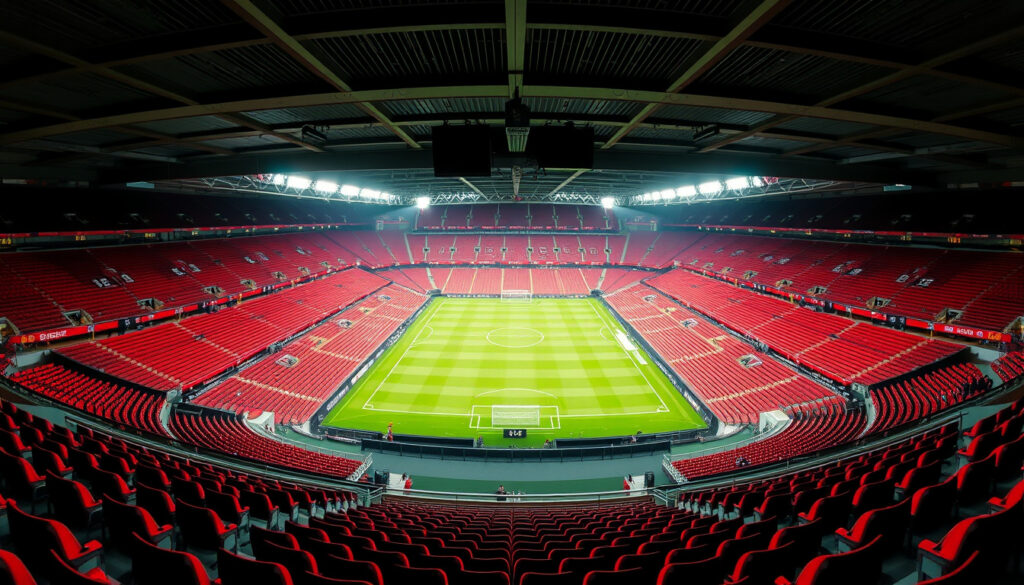
Old Trafford Seating Plan – Seat Numbers, Rows and Best Views
Old Trafford, located in Stretford, Greater Manchester, serves as the home of Manchester United and remains one of the largest club football stadiums in the United Kingdom. With a capacity ranging from approximately 74,197 to 76,312 seats, the venue is split across four main stands, each offering distinct viewing experiences, atmospheres, and facilities. Understanding the stadium’s seating layout can significantly enhance the matchday experience for first-time visitors and regular attendees alike.
Whether you are securing tickets for a Premier League fixture, a cup tie, or an event at this UEFA Category 4 venue, familiarity with the seating structure—including row numbering, block designations, and section-specific features—can help you select seats that match your priorities, whether those are atmosphere, view quality, or proximity to the players’ tunnel.
Old Trafford Seating Plan with Seat Numbers and Rows
Seats at Old Trafford are organized systematically using a stand prefix, block number, row letter, and individual seat number. Tickets will display the stand, tier or section, row, and seat, making it straightforward to locate your exact position once inside the stadium.
The letter prefix on your ticket indicates the stand: W refers to the West Stand (Stretford End), E to the East Stand, S to the South Stand (Sir Bobby Charlton), and N to the North Stand (Sir Alex Ferguson).
Capacity: 25,500
Blocks: N40–N49
Rows: 102
Best for: Halfway line views
Capacity: 11,500
Blocks: S20–S22
Rows: 48
Best for: Hospitality and media
Capacity: 12,000
Blocks: W10–W16
Rows: 89
Best for: Loud atmosphere, tunnel proximity
Capacity: 11,500
Blocks: E30–E37
Rows: 89
Best for: Away fans, families, disabled access
North Stand (Sir Alex Ferguson Stand)
The North Stand is the largest at Old Trafford, accommodating 25,500 spectators across blocks N40 through N49. It spans 102 rows split across four tiers: the lower tier holds roughly 4,250 seats over 17 rows, the upper tier offers 8,000 seats across 32 rows, Tier 2 provides 8,250 seats in 34 rows, and Tier 3 contains 5,000 seats across 19 rows. This three-tiered structure delivers some of the clearest halfway-line views in the stadium.
South Stand (Sir Bobby Charlton Stand)
The Sir Bobby Charlton Stand features 11,500 seats spread across blocks S20 through S22, organized into 48 rows. The lower tier encompasses 11 rows with approximately 2,500 seats, while the upper tier stretches across 37 rows and holds around 8,500 seats. This stand carries a strong media and hospitality focus.
West Stand (Stretford End)
The Stretford End, designated as the West Stand, seats roughly 12,000 fans across blocks W10 through W16. The lower tier contains 17 rows accommodating about 2,000 seats, the upper tier spans 32 rows with space for 4,000 spectators, and Tier 2 covers 40 rows providing 6,000 seats. The Stretford End is renowned for its energetic atmosphere and its proximity to the players’ tunnel, making it a favoured destination for dedicated home supporters.
East Stand
The East Stand mirrors the West in layout, with blocks E30 through E37 covering 89 rows. The lower tier includes 17 rows with approximately 1,500 seats and incorporates designated disabled access positions in areas such as E133, E144, and E145. The upper tier offers 4,000 seats across 32 rows, while Tier 2 holds 6,000 seats in 40 rows. A scoreboard and family zones are also housed within this stand.
- The stadium contains approximately 328 rows combined across all four main stands.
- Safe standing capacity stands at 13,577 spaces.
- 165 executive boxes are available, concentrated primarily in the North Stand.
- 104 disabled spaces exist throughout the venue, provided free of charge to MUDSA members.
- Old Trafford opened in 1910, with its most recent major redevelopment completed in 2006.
- Family-dedicated blocks include designations such as FAMW206 through FAMW212 in the West and South Stands.
| Stand | Capacity | Blocks | Rows | Key Features |
|---|---|---|---|---|
| North (Sir Alex Ferguson) | 25,500 | N40–N49 | 102 | Three-tiered, best halfway views |
| South (Sir Bobby Charlton) | 11,500 | S20–S22 | 48 | Hospitality, media |
| West (Stretford End) | 12,000 | W10–W16 | 89 | Loudest home end, tunnel-adjacent |
| East | 11,500 | E30–E37 | 89 | Away fans, families, disabled access |
Old Trafford Seating Plan Views from Seats
Understanding what you can expect to see from specific seating areas helps in making an informed choice. Several online platforms provide user-submitted photographs and seat views that illustrate perspectives from individual rows and blocks.
Interactive Seat View Tools
Interactive 3D seating maps are available through platforms such as 3D Digital Venue and SeatPick, allowing users to select individual seats and view their sightlines. These tools are particularly useful for checking obstructed-view risks and comparing different tiers before purchasing tickets.
The A View From My Seat community compiles real photographs uploaded by spectators, offering authentic perspectives directly from the seats specified. Similarly, TickPick provides interactive seating charts that display row-level details.
Views from lower and mid-tier sections in the side stands generally provide the most balanced perspective of the pitch. The roof may partially affect visibility in the highest tier rows, particularly during evening matches under floodlights.
View Quality by Section
The North Stand delivers some of the most sought-after halfway-line perspectives due to its elevation and central positioning. The Stretford End offers an end-on perspective that many supporters prefer for its sense of drama, particularly when play develops toward the goal nearest the tunnel. The Sir Bobby Charlton Stand’s elevated upper tier provides a comprehensive overview of team formations and tactical movement.
The official Manchester United website showcases seat views for hospitality areas, including The International suite, which helps visitors evaluate premium seating options.
Away Fans and Specific Section Seating at Old Trafford
For supporters travelling to Old Trafford as part of an away contingent, understanding the away fan allocation is essential. Away fans are positioned in the southeast corner of the stadium, spanning four blocks that sit between the East Stand and the South Stand.
Where Away Fans Are Seated
The away fan allocation occupies blocks across the lower and upper tiers of the East Stand, specifically in the southeast corner, with seating typically provided for thousands of travelling supporters. Tickets for away sections should be purchased through official club channels to ensure genuine allocation and pricing.
Purchasing tickets through unofficial resale platforms carries the risk of receiving invalid or overpriced tickets. Official sources such as the Manchester United ticketing portal remain the most reliable method for securing genuine away match tickets.
The Stretford End and the Players’ Tunnel
The Stretford End holds a unique position at Old Trafford as the primary home end. Situated directly behind the west goal, it is the loudest area of the stadium and sits adjacent to the players’ tunnel, meaning spectators in the lower and mid-tier rows frequently have views of team warm-ups and post-match celebrations.
Seats in the higher rows of the Stretford End tend to be the most sought after, as they combine strong atmosphere with a broader vantage point of the full pitch. Families with younger children may prefer the designated family blocks in the West and South Stands, which offer a more controlled environment while still providing good views of the action.
3D Seating Plan and Capacity Overview for Old Trafford
The overall seating capacity of Old Trafford spans from approximately 74,197 to 76,312 seats, depending on the event configuration and any temporary seating adjustments for specific matches. This range accounts for variations between general admission, hospitality, and standing configurations.
Using 3D Seating Maps
A range of digital tools enables prospective visitors to explore the stadium layout in three dimensions before committing to a ticket purchase. 3D Digital Venue provides a comprehensive interactive map tailored specifically for Manchester United fixtures. These tools allow users to filter by stand, tier, block, and even specific row numbers to find seats that meet their preferences.
For a more community-driven experience, A View From My Seat offers photographs uploaded by actual spectators sitting in specific locations throughout the stadium. This resource is particularly valuable for gauging real-world view quality, as images are taken directly from the seats themselves rather than from design renderings.
Capacity Breakdown by Stand
When the four main stands are combined, the North Stand accounts for roughly a third of the stadium’s total capacity at 25,500 seats. The West and South Stands each hold approximately 11,500 to 12,000 seats, while the East Stand accommodates a similar number, bringing the combined total comfortably within the widely cited 74,000 to 76,000 seat range for major matches.
For more context on upcoming Manchester United fixtures, the Wolves vs Man United – Preview, Prediction and Key Stats guide covers recent form, key players, and tactical expectations that may influence which seating areas prove most popular.
Matchday Atmosphere and Visitor Experience
Atmosphere varies considerably across the different stands. The Stretford End remains the emotional heartbeat of Old Trafford, where chanting and singing are most persistent and where the sense of collective support is most concentrated. Visitors seeking an immersive matchday experience typically gravitate toward this section.
The East Stand offers a more diverse environment, with family zones and accessibility provisions creating a welcoming space for supporters with children or those requiring additional assistance. The South Stand’s hospitality focus draws a different demographic, including corporate guests and media personnel, which can alter the overall tone of crowd engagement in that area.
Accessibility and Support Facilities
Old Trafford provides 104 disabled spaces throughout the venue, and these are made available free of charge to members of the Manchester United Disabled Supporters Association (MUDSA). Accessible seating positions are distributed across multiple stands, with dedicated spaces in the East Stand notably including positions E133, E144, and E145.
Facilities for visitors with reduced mobility include accessible parking, assistance points, and viewing areas designed to meet UEFA Category 4 accessibility standards. These provisions make the stadium one of the more accessible major venues in European football.
Confirmed Details and Areas of Uncertainty
- Total capacity approximately 74,197–76,312
- Four main stands with defined capacities
- Stretford End holds 12,000 across W10–W16
- Away fans allocated in southeast corner
- 328 total rows across all stands
- Safe standing: 13,577 spaces
- Exact block numbers for away allocations may vary per match
- Precise seat counts per individual row can fluctuate
- Event-specific configurations may alter visible capacity
- Family block designations subject to change
Official Sources and Further Information
For the most current ticketing information, seating availability, and stadium access guidelines, the official Manchester United ticketing portal provides direct access to ticket sales and verified information. Venue hire and event booking details are available through the Manchester United venue hire page.
Old Trafford holds a special place in the history of English football, having witnessed countless defining moments since opening in 1910. Its continued development, most recently in 2006, reflects Manchester United’s commitment to maintaining a world-class facility for supporters and events alike.
— Historical context drawn from Wikipedia and official club records
For broader context on the England national team schedule at major venues, the England National Football Team Games – 2026 Fixtures and TV Guide provides a comprehensive overview of upcoming international fixtures.
Summary
Understanding the Old Trafford seating plan requires familiarity with the stadium’s four main stands, their respective block and row structures, and the distinct characteristics each section offers. The North Stand leads in capacity and view quality for central positioning, while the Stretford End provides the most vibrant atmosphere and tunnel-side proximity. Away supporters are accommodated in the southeast corner, and interactive digital tools enable prospective visitors to preview specific seats before purchase. With confirmed capacities ranging between roughly 74,000 and 76,000 seats and a range of accessibility options, Old Trafford remains a benchmark venue for both domestic and international football.
Frequently Asked Questions
What is the seating capacity of Old Trafford?
Old Trafford accommodates approximately 74,197 to 76,312 seats across its four main stands, making it one of the largest club football stadiums in the United Kingdom.
Where do away fans sit at Old Trafford?
Away fans are allocated seating in the southeast corner of the stadium, occupying four blocks that span the lower and upper tiers between the East Stand and the South Stand.
How do I see a 3D view of Old Trafford seats?
Interactive 3D seating maps are available through platforms such as 3D Digital Venue, SeatPick, and A View From My Seat, all of which provide detailed seat-by-seat previews for Old Trafford.
How many rows are there in the Stretford End?
The Stretford End spans a total of 89 rows, split across three tiers: lower (17 rows), upper (32 rows), and Tier 2 (40 rows).
Which stand has the best atmosphere at Old Trafford?
The Stretford End is widely regarded as having the best atmosphere, with its close proximity to the players’ tunnel and consistent supporter chanting throughout matches.
Are there accessible seats at Old Trafford?
Yes, the stadium provides 104 disabled spaces distributed across multiple stands, with dedicated accessible positions in areas such as E133, E144, and E145 in the East Stand. These spaces are free for MUDSA members.
How is the seating organized by stand prefix?
Seats are organized by a letter prefix indicating the stand: W denotes the West (Stretford End), E the East, S the South, and N the North. This is followed by the block number, row letter, and individual seat number.
More related posts
 Garden Tower Defense Codes – Fast Rewards & Easy Upgrades
 A Thousand Blows Cast: Characters, True Story & Season 2 News
 End of Life Signs – Key Indicators and What They Mean
 Brooke Shields: Health, Feuds, and Family Story
 BBC News NI Live – Watch Free on iPlayer UK Guide
 Simply Red Tour 2025 – Dates Tickets Presale Info
 Cost of Living Crisis UK 2025: Is It Still Ongoing?
 Dune (2021): Hit or Flop? Box Office, Screen Time & Tarantino