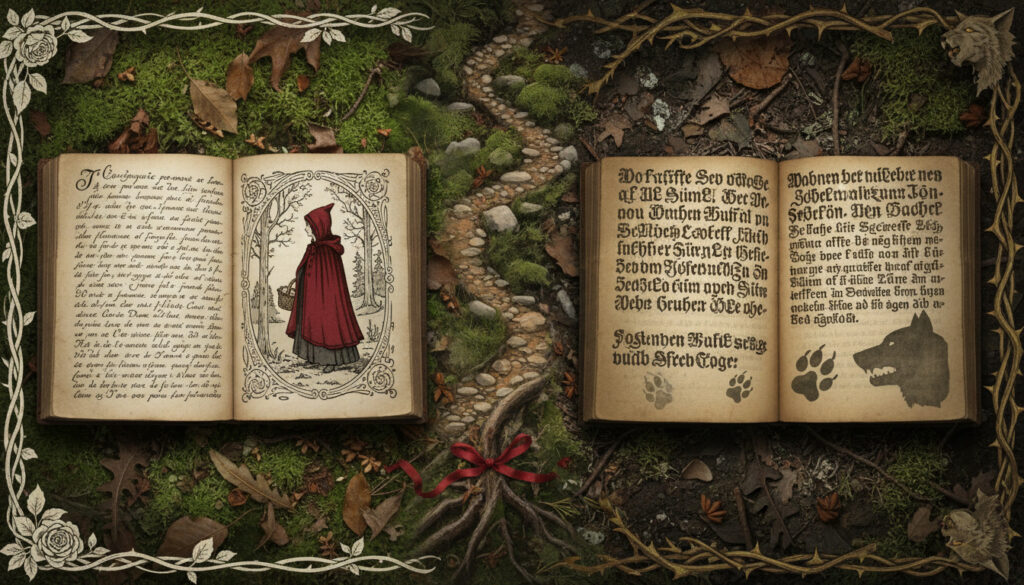
Little Red Riding Hood – Perrault vs Grimm Origins
Little Red Riding Hood remains one of the world’s most recognizable fairy tales, depicting a young girl’s perilous journey through the woods and her encounter with a cunning wolf disguised as her grandmother. The story has transcended its European folklore origins to become a universal metaphor for innocence, deception, and the transition from childhood to adulthood.
While most contemporary audiences know the tale through animated films and picture books, the literary history of this narrative spans centuries and contains significantly darker elements than modern adaptations suggest. Versions collected by Charles Perrault and the Brothers Grimm differ radically in tone, outcome, and moral instruction, reflecting evolving cultural attitudes toward youth, gender, and protection.
The narrative follows a young girl, distinguished by her red hood or cap, who travels through a forest to deliver provisions to her ailing grandmother. A wolf intercepts her, learns of her destination, devours the grandmother, assumes her appearance, and ultimately attempts to consume the girl—though specific outcomes vary dramatically by version.
What Is Little Red Riding Hood About?
- At least 58 distinct versions exist across cultures, with some oral variants dating back approximately 1,000 years
- Charles Perrault’s 1697 version features a tragic ending where both Red and her grandmother perish
- The Brothers Grimm introduced the huntsman savior and happy ending in their 1812 collection
- The tale belongs to the Aarne-Thompson-Uther classification 333, known as “The Glutton”
- Modern Disney adaptations and children’s books significantly soften the darker violence present in original texts
- The story influenced the development of the modern horror genre through its predatory antagonist
- Wolf symbolism extends beyond animal threat to represent human sexual predators
| Aspect | Details |
|---|---|
| First Literary Publication | 1697 by Charles Perrault |
| German Title | Rotkäppchen (Little Red Cap) |
| ATU Tale Type | 333 (The Glutton) |
| Original French Title | Le Petit Chaperon Rouge |
| Grimm Collection | 1812 (Kinder- und Hausmärchen) |
| Setting | European forest village |
| Central Conflict | Deception by anthropomorphic wolf |
| Key Objects | Red hood/cap, basket of provisions, grandmother’s house |
| Perrault Ending | Fatal consumption by wolf |
| Grimm Ending | Rescue by huntsman, wolf killed |
Who Wrote Little Red Riding Hood and Where Does It Come From?
Researchers have identified at least 58 recorded variants of the tale, with evidence suggesting oral traditions existed roughly 1,000 years before Perrault’s publication, indicating the story emerged from ancient folklore rather than a single author’s imagination.
Pre-Literary Origins
The story existed as part of European oral tradition long before written documentation. Folklorists classify it under the Aarne-Thompson-Uther system as type 333, “The Glutton,” connecting it to similar tales of voracious beasts and clever children across multiple continents. These oral narratives likely served as cautionary tales warning children about literal wolves in forests and metaphorical predators in society.
Charles Perrault’s 1697 Publication
Charles Perrault first committed the tale to print as “Le Petit Chaperon Rouge” in his collection Histoires ou contes du temps passé. Working within the French court of Louis XIV, Perrault adapted folk material for aristocratic audiences, embedding explicit moral lessons at tale’s end. His version concludes tragically, with no rescue forthcoming, reflecting a harsher worldview regarding childhood vulnerability.
The Brothers Grimm Adaptation
Jacob and Wilhelm Grimm included the story as “Rotkäppchen” (Little Red Cap) in the 1812 edition of Children’s and Household Tales. The Grimms significantly altered the narrative by introducing the huntsman character who rescues grandmother and girl by cutting open the wolf’s belly. Their version also adds a second wolf encounter, emphasizing learning from experience and community protection.
What Is the Moral of Little Red Riding Hood?
Warnings Against Stranger Danger
Both canonical versions emphasize the perils of engaging with unknown individuals. Perrault renders this lesson explicit through a concluding moral directed specifically toward young women, warning that charming strangers may conceal predatory intentions. The Grimms convey similar warnings through the mother’s instruction to remain on the forest path, with deviation resulting in mortal danger.
The Wolf as Predator
The wolf symbolizes real-life sexual predators who exploit vulnerable youth through charm and deception. Perrault’s version presents men exclusively as dangerous, while the Grimms complicate this dichotomy by introducing the huntsman as a protective paternal figure. This shift reflects changing 19th-century attitudes toward masculine roles as guardians rather than merely threats.
Pathway as Metaphor
The forest path represents the journey from childhood innocence toward adult experience. Straying from this protected route—whether tempted by flowers (Grimm) or racing games (Perrault)—symbolizes the dangerous curiosity of adolescence. The grandmother’s house, typically a refuge, becomes compromised, suggesting that even familiar safety can be violated when warnings are ignored.
Perrault concludes his tale with a direct moral stating that “Children, especially attractive, well bred young ladies, should never talk to strangers, for if they should do so, they may well provide dinner for a wolf.”
Perrault vs. Grimm: Key Differences and Original Ending
Endings: Tragedy Versus Triumph
The most significant divergence occurs in the conclusion. Perrault’s wolf devours both grandmother and girl, ending the story without rescue. The Grimms’ version introduces a passing huntsman who hears the wolf’s snoring, cuts open the beast’s belly to release the living victims, and fills the cavity with stones to drown the wolf when he attempts to flee. This redemption narrative transforms the tale from cautionary tragedy into resilience myth.
Character Behavior and Agency
Perrault depicts Red as significantly more naive—she actually disrobes and gets into bed with the wolf. In contrast, the Grimm heroine stands beside the bed, questioning the disguised wolf’s large ears, eyes, hands, and teeth, demonstrating greater wariness. The Grimms also grant the grandmother active participation in defeating a second wolf, whereas Perrault renders her purely as victim.
In Perrault’s version, the wolf tricks Red into bed by claiming he wishes to race to the grandmother’s house, while the Grimms depict the wolf enticing Red with blooming flowers, demonstrating different mechanisms of manipulation.
Maternal Warnings and Community Focus
Perrault’s mother offers no specific instructions about the forest path. The Grimms’ mother explicitly warns: “walk nicely and quietly and do not run off the path”—a command that creates dramatic irony when Red disobeys. Additionally, Perrault emphasizes Red is loved only by her mother and grandmother, while the Grimms describe her as “loved by everyone that looked at her,” establishing a broader community concern for her safety.
Unlike Perrault’s single incident, the Brothers Grimm appended a sequel where a second wolf attempts the same deception, but Red and her grandmother actively participate in defeating the threat by boiling water and luring the animal into a trap, demonstrating learned wisdom.
Modern Adaptations and Cultural Impact
Contemporary retellings, including Disney animated features and children’s picture books, diverge significantly from both Perrault and Grimm source material. Modern versions typically eliminate the violent consumption of protagonists and the explicit predatory sexuality implied in early texts, transforming the narrative into a mild adventure suitable for preschool audiences.
The 2011 film Red Riding Hood and similar adaptations reimagined the tale as gothic romance and horror, returning to darker themes but through a lens of teenage rebellion and supernatural mythology. These iterations frequently emphasize the transformative power of belief and community protection, though often substituting romantic subplots for the original moral lessons about obedience and stranger danger.
How Did Little Red Riding Hood Evolve Through the Centuries?
- : Oral circulation of ATU 333 tales across European peasant communities, serving as cautionary instruction for children navigating dangerous forests and social predators.
- : Charles Perrault publishes “Le Petit Chaperon Rouge” with tragic ending in Histoires ou contes du temps passé, establishing the first literary canon.
- : Jacob and Wilhelm Grimm include “Rotkäppchen” in Children’s and Household Tales, introducing the huntsman savior and transforming the narrative into a redemption story.
- : Victorian illustrated editions explode in popularity, establishing visual iconography of the red hood and grandmother’s cottage that persist today.
- : Film adaptations including Disney animations and 2011’s Red Riding Hood soften violent elements for family audiences, while academic feminist and psychoanalytic reinterpretations explore themes of puberty and sexual awakening.
What Is Definitively Known About Little Red Riding Hood’s History?
| Established Information | Information Remaining Unclear |
|---|---|
| Perrault published the first literary version in 1697 | Specific oral variants from pre-1697 cannot be definitively reconstructed |
| Brothers Grimm collected their German version in 1812 | Exact geographic origin of earliest tales remains debated among folklorists |
| Tale classified as ATU 333 in international folklore indexes | Whether specific real events inspired the narrative structure |
| At least 58 distinct versions documented across cultures | Precise dating of oldest oral traditions (claims of 1000 years lack specific manuscript evidence) |
| Red hood symbolism universally recognized | The “original” moral intention of prehistoric tellers |
What Cultural Context Shaped Little Red Riding Hood?
The narrative emerged from societies where forests represented literal danger—home to wolves and bandits—and where young girls faced genuine threats during solitary travel. The archetypal journey through dangerous territories reflects universal coming-of-age rituals found across cultures, wherein adolescents must navigate treacherous passages between protected childhood and responsible adulthood.
Psychological interpretations suggest the wolf represents the id or unrestrained male sexuality, while the red hood symbolizes menstruation and sexual maturity. Anthropological readings view the tale as documenting historical European werewolf panics or literal warnings about animal attacks. The persistence of the narrative across millennia suggests it addresses fundamental human anxieties regarding vulnerability, trust, and the loss of innocence. Psychological interpretations suggest the wolf represents the id or unrestrained male sexuality, while the red hood symbolizes menstruation and sexual maturity, themes also explored in works like My Big Fat Greek Wedding.
What Do Primary Sources Say About Little Red Riding Hood?
“Children, especially attractive, well bred young ladies, should never talk to strangers, for if they should do so, they may well provide dinner for a wolf.”
— Charles Perrault, Histoires ou contes du temps passé, 1697
“Walk nicely and quietly and do not run off the path, otherwise you will fall and break the glass, and then there will be nothing for your sick grandmother.”
— Jacob and Wilhelm Grimm, “Little Red Cap,” Kinder- und Hausmärchen, 1812
Primary texts are available through Perrault’s original French and the Grimm Brothers’ German, with English translations provided by D.L. Ashliman at the University of Pittsburgh.
Why Does Little Red Riding Hood Endure?
The tale persists because it operates simultaneously as simple entertainment and complex psychological allegory. Whether encountered as a child’s first lesson in stranger danger or analyzed as a narrative of sexual awakening and patriarchal protection, the story accommodates multiple interpretations while maintaining its core tension between innocence and experience. Its adaptability—from Perrault’s tragic warning to Grimm’s triumph of community values—ensures relevance across shifting cultural anxieties about childhood safety and female agency.
Frequently Asked Questions
Is Little Red Riding Hood based on a true story?
No specific historical event documents a girl eaten by a wolf impersonating her grandmother. The tale derives from ancient European oral folklore, with at least 58 documented variants existing before literary publication, suggesting it emerged from communal cautionary traditions rather than singular historical fact.
What is the original ending of Little Red Riding Hood?
The earliest literary version by Charles Perrault (1697) ends tragically: the wolf devours both Little Red Riding Hood and her grandmother, with no rescue. The Brothers Grimm later modified this in 1812 to include a huntsman who cuts them free from the wolf’s belly.
Why is it called Little Red Riding Hood?
Charles Perrault introduced the specific red chaperon (hood) in 1697. The color red symbolizes danger, sexual maturity, or vitality depending on interpretation. Earlier oral versions featured various red caps or cloaks, but Perrault’s “chaperon” became the definitive visual identifier.
How many versions of Little Red Riding Hood exist?
Researchers have identified at least 58 distinct versions across cultures, with some oral traditions dating back approximately 1,000 years according to Smithsonian research, though exact dating of prehistoric oral tales remains uncertain.
What does the wolf represent in the story?
The wolf symbolizes predatory danger, specifically male sexual predators who exploit vulnerable youth through charm and deception. Perrault’s version emphasizes the wolf as irredeemable danger, while later interpretations explore the duality of men as both protectors (huntsman) and threats (wolf).
Did the Brothers Grimm invent the huntsman character?
Yes, the huntsman savior appears exclusively in the Brothers Grimm 1812 version “Rotkäppchen.” Charles Perrault’s 1697 tale contains no rescue figure, ending instead with the wolf’s successful consumption of both victims.
Is the story appropriate for young children?
Modern adapted versions are suitable for children, but original Perrault and Grimm texts contain graphic violence including consumption of protagonists and disembowelment of the wolf. Parents should preview editions, as uncensored versions may disturb sensitive young readers.
More related posts
 Bilete de Avion Ieftine: Best Sites Compared
 Mumbai Indians vs Delhi Capitals Match Scorecard – IPL 2024 Full Stats & Highlights
 Porsche Macan for Sale – 5-Year Costs and Buying Guide
 Latest Scottish Football News – Hearts Lead by 7 Points
 Mila Kunis: Children, Husband, Net Worth, Scars, and More
 Tour of Britain 2025 – Race Review And Key Insights
 Asda Jobs Near Me: How to Apply, Pay & Interview Tips
 When Is the Longest Day of the Year? Dates by Hemisphere