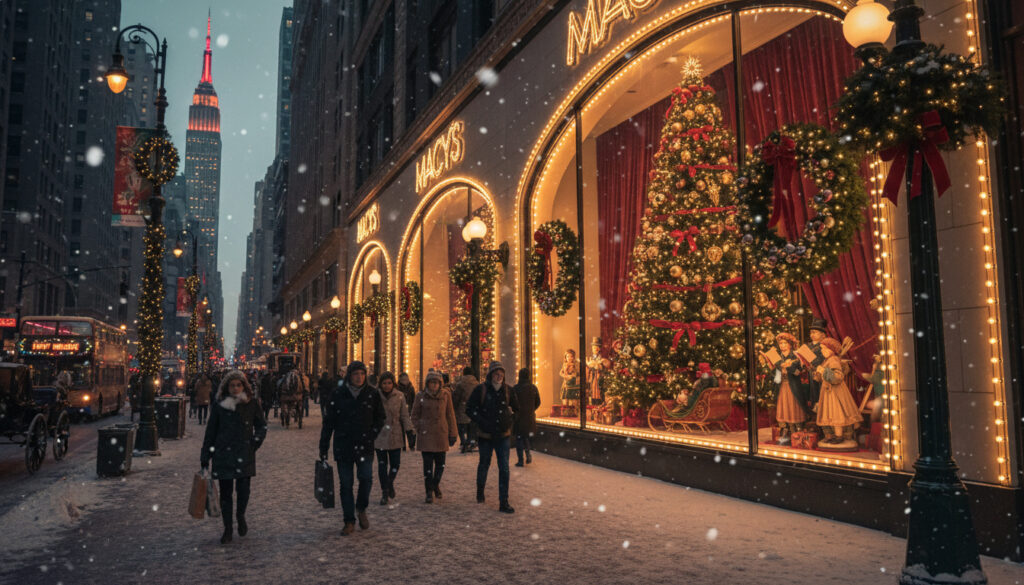
Miracle on 34th Street – Trusted Holiday Icon
A fixture of holiday viewing since 1947, “Miracle on 34th Street” stands as a defining Christmas film. Set in postwar New York, this cinematic milestone weaves together realism and belief, challenging both characters and audience to answer if Santa Claus exists—or if the magic lies elsewhere.
At its center is Kris Kringle, a department store Santa whose claim to be the real thing leads to a courtroom drama. The film explores skepticism and the power of faith, inviting viewers to consider the role of imagination in shaping holiday traditions. Its legacy has only grown with time, inspiring generations and adaptations around the world.
For more analysis, visit Public Ledger.
What is Miracle on 34th Street about?
- Title: Miracle on 34th Street
- Release Date: 1947
- Director: George Seaton
- Genre: Family, Holiday, Drama
- Defined Christmas film traditions
- Inspired legal-proof tropes of holiday magic
- Annual broadcasts cemented its status
- Became a symbol of belief versus cynicism
- Inspired by real Macy’s Santa
- Filmed during actual Parade
- Oscar for Edmund Gwenn’s portrayal
- Remakes update setting and context
- Won Academy Award for Best Supporting Actor
- Praised for warmth and realism
- Popular with audiences and critics
- Recognized by film historians
- Balances hope and skepticism, offering a thoughtful reflection on belief in the modern world.
- George Seaton’s direction and Edmund Gwenn’s Oscar-winning performance shaped its distinct character.
- Continues to thrive through annual broadcasts and critical acclaim.
- Story built on real Macy’s Parade and department store practices.
- Inspired direct remakes and countless homages in film and television.
- The film sparked debates on commercialism and the true spirit of the holidays.
| Release Year | Director | Key Cast | Genre | Awards | Notable Remakes |
|---|---|---|---|---|---|
| 1947 | George Seaton | Edmund Gwenn, Maureen O’Hara, John Payne, Natalie Wood | Family, Holiday, Drama | Best Supporting Actor Oscar (Edmund Gwenn) | 1994 feature remake, TV versions |
How has Miracle on 34th Street influenced holiday films and culture?
Why has Miracle on 34th Street become synonymous with Christmas cinema?
The film’s message—blending rational doubt with genuine faith—has made it an enduring holiday staple. According to Literary Mama, Kris Kringle’s insistence that “Christmas isn’t a day, it’s a frame of mind” resonated across postwar America and beyond. Its annual television broadcasts helped anchor it in seasonal celebrations, making the title instantly recognizable.
What lasting cultural impact has the film had?
“Miracle on 34th Street” shaped public perceptions of Santa Claus and influenced legal and psychological depictions in cinema. Its famous courtroom sequence, wherein sacks of United States Postal Service letters serve as proof of Kringle’s identity, inspired countless legal-themed holiday plots. The film’s critique of commercialism and embrace of childlike faith continue to be relevant, as highlighted by film historians and cultural critics.
Annual broadcasts of the film became a December ritual for many American families, reinforcing its association with Christmas and influencing the popularity of televised holiday specials. Source
How did the film inspire other movies and media?
The idea that belief—rather than just evidence—can transform lives was adopted by numerous later films. The courtroom drama element became a model for portraying holiday magic within rational settings. According to Britannica, the film also cemented the Macy’s Thanksgiving Day Parade as a cultural icon and influenced portrayals of benevolent, realistic Santas in cinema.
How do remakes and reinterpretations compare to the original Miracle on 34th Street?
What changed in later versions?
Remakes, such as the 1994 film, modernized the setting to contemporary New York and introduced new character details, yet retained the central plot of belief on trial. Starring Richard Attenborough and Mara Wilson, this version refreshed the story for a new generation, adapting social attitudes while emphasizing universal themes about hope and family.
While the remake honored the original’s structure—particularly the courtroom climax—it updated supporting details to reflect shifting societal dynamics, such as changes in family structures and the roles of department stores. Source
What do critics say about the differences?
Critics like Roger Ebert praised the 1994 adaptation for its sensitive approach and respectful homage. While some adaptations were noted as less successful, all acknowledged the difficulty of recapturing the original’s unique balance of warmth, skepticism, and cultural context. The 1947 film remains the standard for comparison in discourse on both Christmas films and cinematic remakes.
Later versions found new audiences but did not match the iconic status of the 1947 original, which continues to top critics’ lists for holiday classics. Source
Timeline: Key moments in the history and legacy of Miracle on 34th Street
- 1947: Original film released by 20th Century Fox (source)
- 1948: Edmund Gwenn wins Academy Award for Best Supporting Actor
- 1973: Notable TV adaptation introduces the story to a new medium
- 1994: Feature film remake modernizes the narrative (source)
- 1990s-present: Annual holiday broadcasts reinforce its place in popular culture
- 21st century: The film is referenced in academic studies and major holiday retrospectives
What is known for certain—and what remains debated?
| Established Facts | Matters Still Unclear |
|---|---|
| Directed by George Seaton, with key performances by Edmund Gwenn and Natalie Wood. | The precise extent of the film’s direct influence on every succeeding holiday film remains subject to debate. |
| Story inspired by real Macy’s Santa John Duvall and screenwriter Valentine Davies’ vision. | Interpretations of the courtroom scene’s federal symbolism vary among scholars. |
| The postal service letter element was groundbreaking, and recognized as shaping federal “proof” tropes in film. | The degree of intentional social critique beyond commercialism remains a topic for film theorists. |
| Remakes faithfully adapted the core plot and themes, updating only surface elements for their eras. | The impact of TV adaptations relative to the original’s influence is not fully documented. |
How do the film’s themes and reputation compare to other Christmas classics?
“Miracle on 34th Street” stands out for its nuanced embrace of faith, skepticism, and community, unlike more fantastical or strictly religious holiday films. Its critical approach to commercialism, belief, and family dynamics places it alongside but distinct from other Christmas classics for its tone and social insights. The film’s reception, including poll rankings and critical reviews, underscores its reputation as both a heartwarming story and a social commentary.
Unlike purely sentimental holiday fare, the narrative’s courtroom tension, realistic setting, and humor drew parallels with postwar American anxieties and aspirations. Its enduring box office success and critical acclaim affirm its influence on decades of holiday storytelling.
Key sources and perspectives on Miracle on 34th Street
“Kris Kringle’s remarkable warmth and authenticity made him the screen’s greatest Santa, bridging the gap between fable and reality.”
Film Folly (source)
“A gentle battle between cynicism and belief—rooted in the firm realities of postwar life—has kept this film relevant for generations.”
Literary Mama (source)
In summary: Why does Miracle on 34th Street remain a shining example of holiday cinema?
Decades after its debut, “Miracle on 34th Street” endures for its unique mix of wit, heart, and social reflection. Its influence reverberates in holiday culture and cinema alike, with the original film recognized by historians and audiences as a touchstone for festive storytelling. For further exploration, see Miracle on 34th Street (1947).
Frequently asked questions about Miracle on 34th Street
What inspired the original story of Miracle on 34th Street?
Are there any notable differences between the original film and its remakes?
How did audiences initially receive Miracle on 34th Street?
What makes Miracle on 34th Street a perennial favorite during the holidays?
Where can one find authoritative reviews and analyses of the film?
More related posts
 Gaming Realms Share Price – Latest Data, History & Analysis
 Liverpool Predicted Line Up For Today – Team News & Starting XI
 Samsung Galaxy Z Flip 7 – UK Price, Deals and Where to Buy
 Weather in Belfast 10 Days – Unsettled with Frequent Showers
 St Pauls Carnival 2025 – Dates, Tickets and Full Guide
 Eric Bana Biography: Ethnicity, Career, and Movies
 What Is the Best Euro Rate on the High Street Today – Tesco & Post Office Rates
 Simply Red Tour 2025 – Dates Tickets Presale Info