Can You Reheat Prawns – Safe Methods and Tips
Prawns occupy a delicate position in culinary safety protocols. These popular shellfish offer premium protein but deteriorate rapidly under thermal stress, presenting unique challenges for leftover management. Home cooks frequently face the dilemma of salvaging cooked prawns without triggering the rubbery texture or bacterial hazards that improper reheating invites.
The intersection of food science and practical cooking reveals clear boundaries. Reheating prawns is permissible, yet only within specific temporal and thermal constraints. Success requires understanding the protein structure of shellfish and the bacterial risks particular to marine environments, particularly the Vibrio species that thrive in improperly handled seafood.
Navigating these constraints demands precise methodology. From stovetop simmering to controlled microwaving, each technique carries distinct requirements for moisture retention and heat penetration. Mastering these variables ensures both safety and palatability.
Is It Safe to Reheat Prawns?
- Reheating remains safe exclusively for single-use occasions after proper refrigeration
- Temperature must reach 165°F to eliminate shellfish-specific pathogens like Vibrio
- Storage duration cannot exceed 3–4 days at 40°F or below
- Repeated reheating produces irreversible protein toughening and exponential bacterial growth
- Frozen prawns require 6–12 hours of refrigerator thawing before reheating
- Moisture loss during heating accelerates textural degradation
- Post-reheat storage is never recommended; immediate consumption is mandatory
| Method | Size | Duration | Heat Setting | Liquid Requirement | Critical Step |
|---|---|---|---|---|---|
| Stovetop | Small | 2–3 min/side | Medium-low | 2 inches broth/oil | Cover off-heat 1–2 min |
| Stovetop | Large | 4–5 min/side | Medium-low | 2 inches broth/oil | Flip frequently |
| Oven | Any | 5–15 min | 275–300°F | 2–3 tbsp water/broth | Tight foil cover |
| Microwave | Any | 30-sec bursts | Medium-high | Splash water/lemon | Damp towel cover |
| Steam | Any | 20 min | Medium-high | Double boiler water | Basket above waterline |
| Wok | Any | 7–10 min | Medium-high | Cooking spray | Constant stirring |
Best Ways to Reheat Prawns
Stovetop Simmering
Gentle stovetop reheating preserves texture most effectively. Heat a skillet with oil, butter, or broth to medium-low, adding approximately two inches of liquid. Introduce the prawns and simmer or sauté gently, turning as needed. Cover the pan for the final one to two minutes off the heat to distribute residual warmth evenly. Culinary analysis identifies this method as the optimal approach for maintaining moisture.
Liquid is non-negotiable for safe reheating. Broth, water, or lemon juice creates steam that prevents the protein fibers from contracting into a rubbery state. This approach maintains the tender texture characteristic of properly cooked shellfish.
Preparation Fundamentals
Regardless of method, bring prawns to refrigerator temperature if previously frozen. Patting them dry before reheating prevents dilution of flavors, though additional liquid must be introduced during the heating process itself. Work in single layers rather than stacked portions to ensure uniform heat penetration.
Reheating Prawns in the Microwave
Container and Covering
Microwave reheating demands strict moisture protocols. Place prawns in a microwave-safe dish with a splash of water, broth, or lemon juice. Cover tightly with a lid or damp paper towel to trap steam. Kitchen Skip emphasizes that this covering mimics the humid environment of stovetop steaming and prevents the desiccation that occurs in open microwave heating.
Full microwave power creates uneven hot spots that toughen protein instantly. Use medium-high settings in 30-second bursts, stirring or flipping halfway through. Total reheating time should not exceed 7–10 minutes, with internal temperature verified at 165°F.
Power Management
The intermittent heating approach prevents the explosive temperature spikes that ruin texture. Check the prawns after each burst, looking for the opaque pink color that indicates proper warming without overcooking.
Alternative Methods: Oven, Stovetop, or Steam
Oven Baking
For batch reheating, the oven provides consistent low heat. Preheat to 275–300°F and arrange prawns in a single layer on a sheet pan. Add two to three tablespoons of water or broth, then cover tightly with aluminum foil to create a steam chamber. Temperature guidelines suggest heating for 5–15 minutes until reaching the safe internal temperature. This method excels for larger quantities where stovetop management becomes impractical.
Oven reheating allows gradual warming that preserves moisture better than high-heat alternatives. The covered environment prevents evaporative loss while the low temperature avoids shocking the delicate protein structure of the shellfish.
Steam Reheating
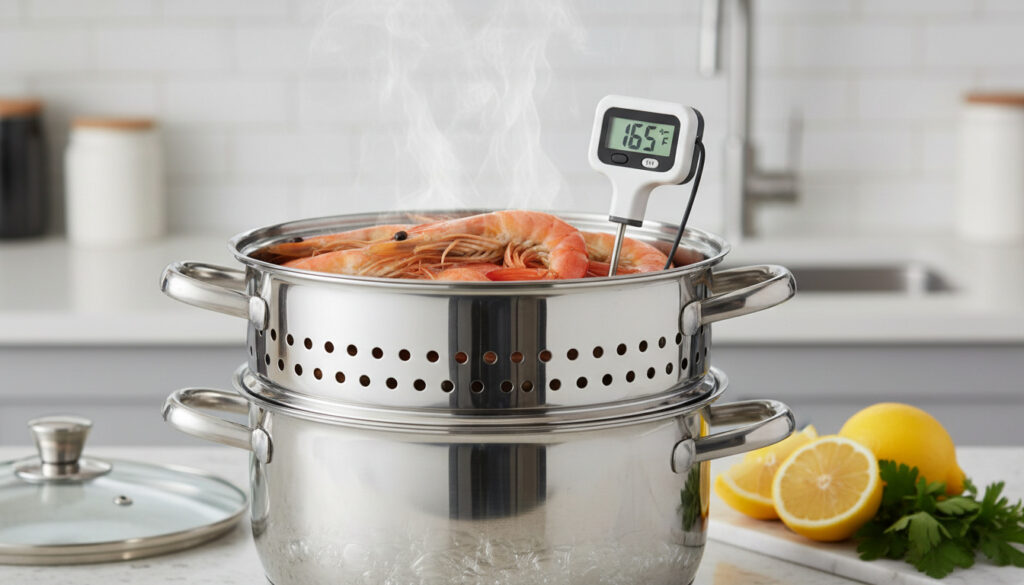
A double boiler setup provides the gentlest reheating environment. Place water in the lower pot and prawns in a basket above, ensuring the shellfish never touch the boiling water directly. Steam for approximately 20 minutes. Seafood specialists note that this method recovers frozen storage quality effectively without the texture loss associated with dry heating methods.
Wok or Pan Techniques
Electric woks or high-sided pans offer rapid reheating for those monitoring time closely. Use medium-high heat with cooking spray, stirring constantly for 7–10 minutes. While efficient, this method requires vigilant attention to prevent burning or uneven heating. Lead Academy notes that frequent stirring is essential for this higher-heat approach.
Storage and Shelf Life After Reheating
- Initial Cooking: Cook prawns to safe internal temperature, ensuring even heat penetration during the first preparation.
- Prompt Refrigeration: Transfer leftovers to refrigeration within two hours of cooking to minimize time in the bacterial danger zone.
- Cold Storage: Maintain at 40°F or below for a maximum of 3–4 days; discard if odors develop or texture becomes slimy.
- Thawing Protocol: For frozen cooked prawns, thaw in the refrigerator for 6–12 hours before reheating; never refreeze after thawing.
- Reheating Event: Heat once to 165°F internal temperature using preferred method, verifying with a thermometer.
- Immediate Consumption: Serve and eat immediately; do not return to storage or attempt secondary reheating.
- Final Disposal: Discard any uneaten reheated portions; do not risk subsequent bacterial proliferation.
What Rules Are Definite and What Remains Variable?
Established Certainties
- Single reheating to 165°F eliminates Vibrio risk
- 3–4 day maximum refrigeration at 40°F
- Liquid addition prevents texture degradation
- Immediate consumption post-reheat is mandatory
- Two-hour window for initial refrigeration
Uncertain or Variable Factors
- Exact texture degradation timeline varies by initial cooking method
- Moisture loss rates depend on prawn size and shell integrity
- Individual immune sensitivity to Vibrio species varies
- Precise microwave timing differs by appliance wattage
Why Does Shellfish Reheating Require Specialized Care?
Prawns and shrimp share identical protein structures that respond poorly to thermal shock. Unlike beef or poultry, shellfish muscle fibers contain higher moisture content and shorter protein chains that denature rapidly when exposed to high heat. This biological reality makes them susceptible to the rubbery, chewy texture that renders them unpalatable.
The marine environment introduces specific pathogens absent in terrestrial proteins. How Long Are You Contagious With Covid – Safe Recovery Tips illustrates how precise biological timelines govern safety protocols across different contexts. Similarly, Vibrio bacteria occur naturally in coastal waters and concentrate in filter-feeding shellfish. These microorganisms proliferate in the temperature danger zone between 40°F and 140°F, making the reheating process a critical control point for foodborne illness prevention. Seafood safety protocols emphasize that reheating to 165°F is necessary to destroy these pathogens.
Understanding these biological factors explains why gentle, moisture-retaining methods prove superior. The goal is thermal restoration without protein destruction, a balance achievable only through controlled, liquid-assisted heating.
What Do Food Safety Authorities Recommend?
Reheating cooked prawns only once after proper initial storage prevents the rubbery texture and bacterial growth risks associated with multiple temperature cycles through the danger zone. Aim for an internal temperature of 165°F to kill pathogens like Vibrio common in shellfish.
— Lead Academy Food Safety Research
High or direct heat dries out or toughens shellfish. Always add moisture and cover during reheating to maintain the delicate texture that makes prawns desirable.
— Culinary Technique Analysis
Steaming or simmering excels for frozen storage recovery without quality loss, preserving the integrity of previously cooked shellfish better than dry heat methods.
— Pine Tree Seafood Guidelines
How Can You Ensure Safe Reheating Every Time?
Successful prawn reheating hinges on respecting the single-use limitation and thermal precision. Verify your refrigerator maintains 40°F or below, and never exceed the 3–4 day storage window. When reheating, prioritize moist, gentle methods over rapid high-heat approaches, and confirm the 165°F internal temperature with a reliable thermometer. How Long Are You Contagious With Covid – Know Your Risk reminds us that precise timing matters in biological safety protocols, whether managing viral contagion or bacterial food safety. Consume immediately and discard remnants without hesitation.
Frequently Asked Questions
Can you eat cold prawns without reheating?
Yes, if they were cooked properly, refrigerated within two hours, and consumed within 3–4 days. Cold prawns pose no additional risk compared to other properly stored cold seafood.
How long do cooked prawns last in the refrigerator?
Cooked prawns remain safe for 3–4 days when stored at 40°F or below. Discard immediately if they develop off-odors, sliminess, or discoloration.
What is the safe internal temperature for reheated prawns?
Reheated prawns must reach 165°F internally to eliminate Vibrio bacteria and other shellfish pathogens. Use a food thermometer to verify.
Can you reheat cooked prawns from frozen without thawing?
While possible, reheating from frozen produces uneven results. Thawing in the refrigerator for 6–12 hours ensures uniform heating and better texture retention.
Why do reheated prawns become rubbery?
Overheating or multiple reheating cycles cause protein fibers to contract and toughen. High heat without moisture accelerates this textural degradation.
Is it safe to eat prawns that smell fishy after reheating?
No. Any ammonia-like, sour, or pronounced fishy odor indicates spoilage. Do not taste or consume prawns with off-odors; discard them immediately.
Can you reheat prawns in a sauce or curry?
Yes, simmering prawns gently in sauce provides ideal moisture retention. Ensure the prawns reach 165°F and the sauce simmers without boiling vigorously.
More related posts
 Simply Red Tour 2025 – Dates Tickets Presale Info
 Adam Peaty: Why His Mum Missed His Wedding, Name Change & ADHD
 Property for Sale Fife – 2025 Prices, Trends & Hotspots
 1.78 m in Feet – Precise Conversion Guide and Insights
 Phil Mitchell: EastEnders hardman illness, catchphrase and family
 How to Screenshot on Chromebook: Easy Keyboard Shortcuts
 Eye Doctor Near Me in Ireland: Clinics, Costs & Specialists
 Angel Reese: Biography, Stats, Relationships & Net Worth (2025)