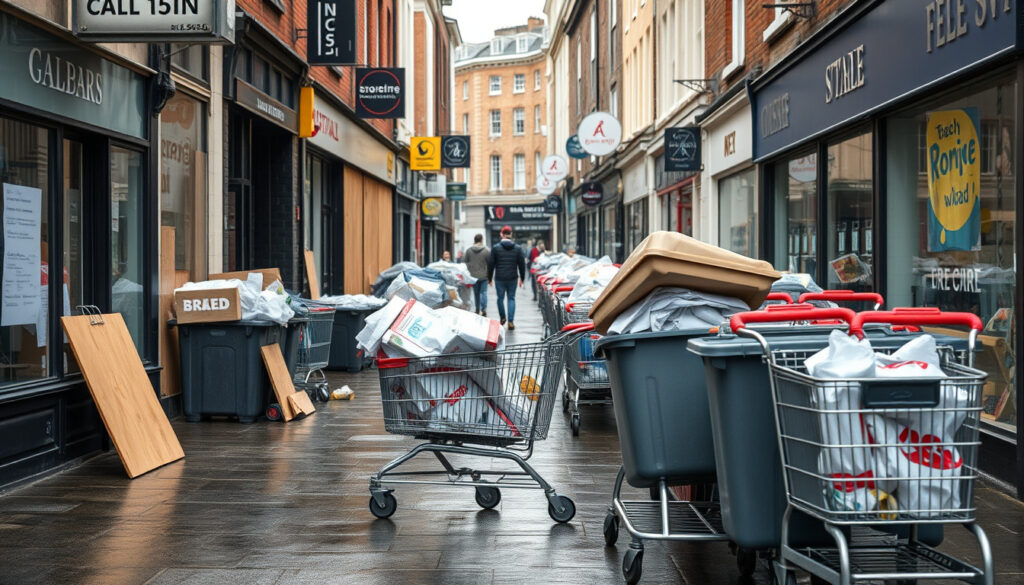
Cost of Living Crisis UK 2025: Is It Still Ongoing?
For millions of British households, the math still doesn’t add up. Wages have inched upward, yet the gap between what comes in and what goes out keeps many families one unexpected bill away from crisis. Three years after the first cost-of-living warning signs, the pressures on everyday budgets show few signs of easing — and fresh economic forecasts suggest the road ahead remains bumpy. The result is an economy where the standard of living that previous generations took for granted feels increasingly out of reach.
Households reporting cost increase: 57% as of Jan 2025 · Crisis onset: Late 2021 · Inflation peak period: 2021-2024 · Average housing deficit for breadline families: £372 · Ongoing impacts noted: Up to April 2026
Quick snapshot
- Whether a formal recession will materialise in 2026 or the UK will narrowly avoid one
- The exact depth and timing of any potential housing market correction
- How long cost pressures will persist beyond 2025 for lower-income households
- Late 2021: Crisis begins as essential prices outpace incomes
- Summer 2022: UK house prices hit all-time high
- May 2023: Regular pay finally outpaces inflation
- March 2025: Stamp duty thresholds fall, stalling market growth
- The Office for Budget Responsibility forecasts earnings growth falling to zero by 2026/27
- Capital Economics predicts house prices will rise only 2.0% to Q4 2025
- Joseph Rowntree Foundation projects disposable incomes declining for the rest of the decade
The following key facts anchor the current picture of the UK’s cost-of-living crisis.
| Metric | Value | Source |
|---|---|---|
| Onset | Late 2021 | Wikipedia |
| Peak inflation | 2021-2024 | Wikipedia |
| Household impact Jan 2025 | 57% increased costs | Wikipedia |
| Housing allowance gap | £372 average deficit | Land Rich |
| Latest news reference | April 2026 Guardian | Land Rich |
The persistence of the £372 housing deficit since 2022 underscores that emergency interventions alone have not resolved the structural affordability gap facing Britain’s most vulnerable households.
Is there still a cost of living crisis in the UK?
The short answer is yes — though the nature of the crisis has shifted since its peak. The Office for Budget Responsibility’s own forecasts show that earnings growth, which hit 2.5% in 2024, is projected to fall to zero by 2026/27, meaning the recovery in real wages is already showing signs of fragility. This comes as the Joseph Rowntree Foundation has projected disposable incomes declining for the rest of the decade, painting a sobering picture of prolonged financial pressure for millions of households.
Current household reports
According to data cited in January 2025, 57% of households reported increased costs compared to previous periods. The Land Rich UK Housing Market analysis documents an average housing deficit of £372 for families trying to maintain a basic standard of living. Crisis UK reported this figure as far back as March 2022, and the gap has persisted despite various government interventions.
Inflation aftermath
While headline inflation has cooled from its 2022 peak, the damage to household budgets has been cumulative. Regular pay did outpace inflation from May 2023 according to Wikipedia’s tracking of the crisis, but the cost of essentials — particularly housing, energy, and food — continued rising faster than general price indices into 2025. The result is that many families find themselves technically “above water” on inflation metrics while still struggling with genuinely higher outgoings.
Policymakers face a harder challenge now: emergency measures that worked in 2022 are not sustainable long-term solutions, and structural affordability problems require structural responses that current policy has not yet delivered.
Why is life so unaffordable in Britain?
Britain’s affordability problem has multiple roots, and understanding them matters because different causes point toward different solutions. The cost-of-living crisis was exacerbated by a toxic combination of factors: the 2022 mini-budget, the COVID-19 pandemic aftermath, the Ukraine war’s impact on energy prices, and Brexit-related trade frictions. Research published in Taylor & Francis traces how these events converged to create the perfect storm that pushed millions of households into financial difficulty.
Essential goods price rises
The most brutal increases came in essentials — the things that cannot be substituted or reduced without fundamental lifestyle changes. Energy bills spiked dramatically in 2022, food prices rose at their fastest rate in decades, and housing costs continued climbing despite efforts to cool the market. What made this particularly damaging was that wages were not keeping pace: the crisis began in late 2021 precisely because prices started rising faster than incomes, and that gap took until mid-2023 to close at the headline level.
Income vs expense gap
The Land Rich analysis reveals the scale of the problem: average UK house prices reached £269,426 by December 2024, up approximately 25% nominally since 2020. Yet house prices have dropped 22% in real terms since 2007 when adjusted for inflation — meaning that while nominal prices look high, the true purchasing power of housing has actually declined over nearly two decades. This creates a paradox where buyers face higher nominal costs while existing homeowners feel less wealthy in real terms.
This paradox helps explain why both first-time buyers and existing property owners feel financially squeezed despite official inflation figures suggesting recovery.
The same low interest rates that made mortgages affordable between 2010-2021 inflated house prices to record levels, and now that mortgage rates have normalised to 4-5% in 2025, affordability has simply shifted from asset prices to monthly repayment costs without resolving the underlying crisis.
Is the UK heading for a recession in 2026?
Economic forecasters are offering a cautiously optimistic view — but optimism should be qualified. CBRE forecasts 1.8% UK economic growth in 2025 with 100 basis points of base rate cuts and stable inflation slightly above the Bank of England’s target. This suggests the UK is likely to avoid a technical recession, defined as two consecutive quarters of negative growth. However, “avoiding recession” is not the same as thriving, and the path to even modest growth is fragile.
Forecast warnings
The Item Club, a leading economic research group, has suggested the UK will narrowly avoid recession but faces a significant surge in the jobless rate. This “jobless recovery” scenario would see unemployment rise even as GDP technically grows — a phenomenon seen in several post-pandemic recoveries elsewhere. The OBR’s own projections show earnings growth falling to zero by 2026/27, which would squeeze household incomes precisely when the labour market is weakening.
Jobless rate projections
The Land Rich analysis highlights how pre-existing economic vulnerabilities compound the recession risk. Private debt, not public debt, represents the core macro risk behind UK economic volatility according to economist Steve Keen, whose analysis of the housing market warns that the UK is “going from crisis to ticking time bomb.” The combination of high private indebtedness, stuttering wage growth, and elevated mortgage rates creates a fragile foundation for economic expansion.
The implication is that even a modest growth forecast carries significant downside risk if unemployment rises faster than anticipated.
The March 2025 fall in stamp duty thresholds has already stalled housing market growth according to Moneyweek, and this pattern could repeat in broader economic indicators if consumer confidence remains depressed. Watch for Q2 2025 GDP data and the Bank of England’s updated unemployment forecasts in August.
Could Britain be heading for a housing crash?
The housing market sits at the intersection of Britain’s cost-of-living crisis, its recession risks, and its long-term structural problems. Capital Economics predicts house prices will rise only 2.0% to Q4 2025, citing stuttering jobs and softening wage growth as headwinds. This forecast suggests a market that is not crashing — but neither is it recovering meaningfully from its recent stagnation.
2026 house price risks
The Land Rich analysis identifies three scenarios that could trigger a house price decline: a potential recession, an unemployment peak, or cost-push inflation. None of these are certain, but all are plausible given current economic conditions. The CBRE UK Real Estate Outlook 2025 notes that new housing supply will remain muted below target despite planning reforms, meaning the fundamental supply-demand imbalance that drives UK house prices is not being addressed by policy.
Broader housing crisis
The affordability crisis extends beyond purchase prices to the rental sector. Rents are becoming unaffordable for many in Great Britain according to Land Rich, while the buy-to-let market is diminishing due to poor capital growth, higher taxes, and increased regulation. Labour’s NPPF revision introduces mandatory housing targets and “grey belt” development in 2025 — a policy shift that could increase supply but faces implementation challenges.
The catch is that without addressing supply shortages and wage-productivity gaps, Britain’s housing affordability crisis will persist regardless of policy announcements.
Homeownership disparities reveal the depth of Britain’s housing crisis across different demographics.
| Comparison | Metric | Source |
|---|---|---|
| Young single homeownership rate | 11% | Lloyds Banking Group |
| Young couple homeownership rate | 52% | Lloyds Banking Group |
| London price-to-income ratio | 12x | UK Housing Crisis Analysis |
| UK price-to-income ratio (current) | 9x | Brutal Truth UK Housing |
| Price-to-income ratio post-war average | ~4.5x | Brutal Truth UK Housing |
Lloyds Banking Group data shows that young single people face an 11% homeownership rate compared to 52% for couples—a disparity that has profound implications for wealth accumulation and retirement planning across generations.
Britain’s housing market has structurally disadvantaged solo buyers, forcing singles to rely on dual incomes or parental support in ways that perpetuate intergenerational wealth inequality.
What is the cost of living crisis?
The cost-of-living crisis is fundamentally a story about the gap between prices and incomes. It began in late 2021 when the prices of essential goods and services started rising faster than household earnings, eroding purchasing power and forcing difficult choices. Unlike other economic downturns, this crisis was not triggered by a financial crash or recession — instead, it emerged from a combination of supply chain disruptions, energy market shocks, and structural weaknesses in the UK economy that had been building for years.
Definition and origins
At its core, the crisis represents a situation where the cost of maintaining a basic standard of living increases faster than the resources available to pay for it. The Taylor & Francis research identifies multiple contributing factors: the economic aftermath of COVID-19, the Russian invasion of Ukraine and its impact on energy markets, and Brexit-related trade disruptions. Each of these factors pushed up prices simultaneously, overwhelming the normal mechanisms that allow economies to adjust gradually.
Key impacts on households
The impacts have been unevenly distributed. Lower-income households, those on fixed incomes, and renters have borne the heaviest burden because essentials (food, energy, housing) make up a larger share of their budgets. The Crisis UK housing deficit figure of £372 illustrates the arithmetic problem: when housing costs consume so much of a low-income family’s budget, there is simply no room for unexpected expenses, savings, or quality-of-life spending.
Timeline
The progression of Britain’s cost-of-living crisis traces specific events that shaped household finances.
| Period | Event | Source |
|---|---|---|
| Late 2021 | Essential goods prices rise faster than incomes; crisis begins | Wikipedia |
| Summer 2022 | UK house prices hit all-time high | Land Rich |
| 2022-2023 | Nominal house prices dip approximately 5.5% during crisis | UK Housing Crisis Analysis |
| May 2023 | Regular pay outpaces inflation for first time since crisis began | Wikipedia |
| March 2025 | Stamp duty thresholds fall; housing market growth stalls | Moneyweek |
| 2026 | Recession and housing crash risks forecasted | Land Rich |
The timeline shows how Britain’s cost-of-living crisis evolved from an acute shock in 2021-2022 into a structural problem that continues to strain household budgets into 2025 and beyond.
Confirmed vs unclear
Three key facts about the UK cost-of-living crisis are firmly established in the evidence. The crisis began in late 2021 when prices outpaced incomes, confirmed across multiple sources including Wikipedia and academic research. The peak inflation period of 2021-2024 created lasting damage to household savings and purchasing power. And the January 2025 data showing 57% of households reporting increased costs demonstrates the crisis has not ended, merely evolved.
On the other hand, several important questions remain genuinely uncertain. Whether a formal recession will materialise in 2026 or the UK will narrowly avoid one is contested among forecasters, with CBRE predicting modest growth while the Item Club warns of jobless recovery. The housing market presents similar ambiguity: Capital Economics forecasts modest 2% price growth, but Land Rich identifies recession, unemployment peaks, or inflation as potential triggers for decline. The Joseph Rowntree Foundation’s projection of income declines through the decade sits alongside these uncertainties, making precise timelines for resolution impossible to establish with confidence.
Expert perspectives
Deposit raising and affordability remains difficult, to the point that we could probably call it the collapse of youth home ownership.
— Lloyds Banking Group (Banking Insights)
Private debt — not public debt — is the core macro risk behind UK housing volatility. The UK’s housing market has gone from “crisis” to “ticking time bomb.”
— Steve Keen (Top Economist)
The cost-of-living crisis was exacerbated by the 2022 mini-budget, COVID-19, the Ukraine war, and Brexit — creating a perfect storm for household budgets.
— Taylor & Francis (Academic Research)
Related reading: Property for Sale Fife – 2025 Prices, Trends & Hotspots
Building on the 2024 crisis update that outlined early household strains since 2021, 57% of UK families still face elevated costs heading into 2025.
Frequently asked questions
What caused the UK cost of living crisis?
The crisis emerged from multiple converging factors: the economic aftermath of COVID-19, the Russia-Ukraine war’s impact on energy prices, post-Brexit trade friction, and domestic policy decisions including the 2022 mini-budget. These factors pushed essential costs higher at the same time, overwhelming household budgets that had not seen corresponding wage growth.
How has Brexit affected UK living costs?
Research published in Taylor & Francis identifies Brexit-related trade disruptions as one of several factors contributing to the cost-of-living crisis. While Brexit’s direct impact on prices is debated among economists, the additional friction it introduced to supply chains combined with other shocks made price control more difficult during 2021-2024.
What are the main impacts on UK households?
The most significant impacts include eroding purchasing power, rising housing costs (both purchase and rent), increased energy and food bills, declining real wages through much of 2021-2023, and the collapse of youth homeownership rates. The Crisis UK figure of £372 average housing deficit for breadline families illustrates the gap facing the most vulnerable households.
Is UK economy in recession now?
As of early 2025, the UK economy has not entered a technical recession. CBRE forecasts 1.8% economic growth for 2025. However, the Item Club suggests the UK may narrowly avoid recession while experiencing a significant surge in unemployment — a “jobless recovery” scenario that offers little comfort to workers.
How to save money during cost of living crisis?
Practical strategies include reviewing energy tariffs and switching providers, using price comparison tools for essentials, accessing government support schemes (which were expanded during 2022-2024), prioritising debt repayment on high-interest products, and where possible, bulk-buying non-perishables. However, the structural nature of the current crisis means individual budgeting alone cannot resolve the underlying affordability problem.
What government support exists?
Government support during the acute phase included the energy price guarantee, cost-of-living payments for vulnerable households, and the household support fund. As of 2025, many of these emergency measures have ended, and policy focus has shifted to structural reforms including Labour’s NPPF revision for housing targets and planning reform.
Will cost of living crisis end in 2025?
The acute phase of the crisis — characterised by double-digit inflation and rapidly falling real wages — has passed. However, the Joseph Rowntree Foundation projects disposable incomes declining for the rest of the decade, suggesting that meaningful relief from affordability pressures is unlikely in the near term. The structural problems (housing costs, weak productivity growth, inadequate wages) will persist beyond any single policy intervention.
More related posts
 Grow a Garden Discord: Official vs Community Servers
 Old Trafford Seating Plan – Seat Numbers, Rows and Best Views
 End of Life Signs – Key Indicators and What They Mean
 Stranger Things Season 5 Runtime – Official Episode Lengths Confirmed
 Horses for Sale Near Me: Cheap & Local Irish Listings
 Frozen Jacket Potato in Air Fryer – Crispy and Fluffy Every Time
 Liberty of the Seas: Dining, Safety, Reviews & 2026 Itinerary
 Paul Doyle Liverpool Parade: Sentence and Timeline