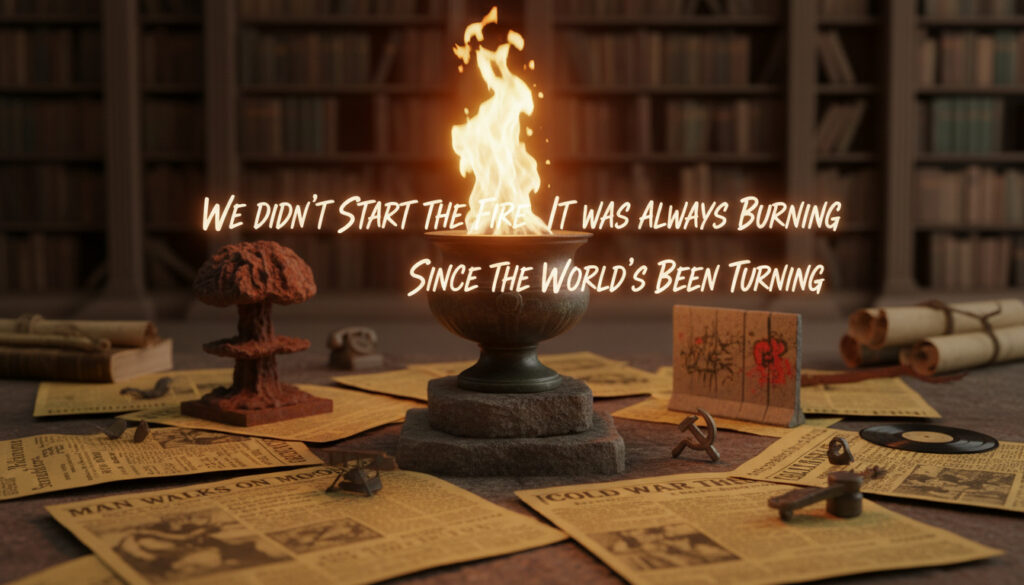
We Didn’t Start the Fire Lyrics – Full Text, Meaning and History
“We Didn’t Start the Fire” compresses forty years of global history into a four-minute rapid-fire delivery that became Billy Joel’s third number-one single. Released in 1989 on the album Storm Front, the track lists 119 specific historical, cultural, and political references spanning from 1949, the year of Joel’s birth, through 1989, creating a chronological catalog that argues Baby Boomers inherited rather than ignited the era’s chaos.
The song emerged from a conversation in which Joel, then approaching forty, defended his generation against accusations that the 1980s were uniquely troubled compared to the supposedly “boring” 1950s. As a self-described “history nut,” Joel countered by demonstrating that every decade carries its own conflicts, tragedies, and transformations.
The lyrics continue to generate analysis decades later, with listeners tracking each allusion and debating the song’s argument about generational responsibility. Educational institutions have used the track as a compressed history lesson, while viral trends and covers have introduced the catalog to new audiences.
What Are the Full Lyrics to Billy Joel’s We Didn’t Start the Fire?
- Chorus argument: The “fire” of historical tragedy has burned continuously “since the world’s been turning”
- Reference density: 119 distinct allusions crammed into verses of approximately four-year intervals
- Chart success: Reached #1 on the Billboard Hot 100, becoming Joel’s third chart-topper
- Melodic structure: Designed as a “train wreck” of rapid syllables to accommodate the word count
- Chronological compression: Each verse covers roughly four years, with references thinning in later decades
- Album placement: Lead single from Storm Front, produced by Mick Jones
| Fact | Details |
|---|---|
| Length | 4:50 |
| Chart Peak | #1 Billboard Hot 100 |
| References Span | 1949–1989 |
| Total References | 119 |
| Songwriter | Billy Joel |
| Producer | Mick Jones |
| Album | Storm Front |
| Release Date | September 18, 1989 |
| Label | Columbia |
| Genre | Pop Rock |
| Structure | Verse-Chorus with Final Variation |
| Birth Year Referenced | 1949 (Joel’s birth) |
Complete Lyric Transcription
The song follows a rigid architecture: rapid-fire historical lists interspersed with the defensive chorus. Transcriptions confirm the following complete structure.
Verse 1
Harry Truman, Doris Day, Red China, Johnny Ray
South Pacific, Walter Winchell, Joe DiMaggio
Chorus
We didn’t start the fire
It was always burning, since the world’s been turning
We didn’t start the fire
No, we didn’t light it, but we tried to fight it
Verse 2
Brando, The King And I, and The Catcher In The Rye
Eisenhower, Vaccine, England’s got a new queen
Marciano, Liberace, Santayana goodbye
Chorus
Verse 3
Davy Crockett, Peter Pan, Elvis Presley, Disneyland
Bardot, Budapest, Alabama, Khrushchev
Princess Grace, Peyton Place, Trouble in the Suez
Chorus
Verse 4
Hula Hoops, Castro, Edsel is a no-go
U-2, Syngman Rhee, payola and Kennedy
Chubby Checker, Psycho, Belgians in the Congo
Chorus
J.F.K. blown away, what else do I have to say?
Chorus
Verse 5
Birth control, Ho Chi Minh, Richard Nixon back again
Moonshot, Woodstock, Watergate, punk rock
Begin, Reagan, Palestine, Terror on the airline
Ayatollah’s in Iran, Russians in Afghanistan
Wheel of Fortune, Sally Ride, heavy metal, suicide
Foreign debts, homeless Vets, AIDS, Crack, Bernie Goetz
Hypodermics on the shores, China’s under martial law
Rock and Roller Cola wars, I can’t take it anymore
Final Chorus
We didn’t start the fire
It was always burning, since the world’s been turning
We didn’t start the fire
But when we are gone, it will still burn on, and on, and on, and on…
What Is the Meaning of We Didn’t Start the Fire Lyrics?
The “Fire” as Perpetual Conflict
The central metaphor frames history as an eternal blaze that no single generation ignites. Joel has explained that the chorus emphasizes continuity: “the fire” of tragedy, technological change, and political upheaval has burned continuously throughout human history.
Joel composed the song after a conversation around age forty with a younger person—possibly Sean Lennon, though sources differ—who characterized the 1980s as uniquely difficult compared to the “boring” 1950s. Joel responded by listing Korean War conflicts and Suez Crisis tensions to demonstrate that every era carries its own crises.
Generational Responsibility
The lyrics function as a specific rebuttal to accusations that Baby Boomers had somehow caused the world’s problems. By cataloging events from Truman’s presidency through the Tiananmen Square protests, Joel argues that his generation inherited ongoing global chaos rather than creating it.
The Accelerating Pace of Memory
Analysis reveals that reference density decreases across decades. The 1950s verses burst with pop culture artifacts and political milestones, while the 1980s compress complex issues like AIDS, terrorism, and foreign debt into fewer syllables. This structural choice reflects the narrator’s closer memory of youth versus the darker, more complicated recent history.
What Historical References Are in the Lyrics?
Britannica provides detailed explanations for all 119 allusions, which include presidents, wars, inventions, entertainment figures, and scientific milestones arranged in near-chronological order.
1949–1959: Cold War Foundations
The opening verse mixes Harry Truman’s 1949 presidency with Doris Day’s film career and Johnny Ray’s musical hits. “Red China” references the 1949 Communist revolution, while “England’s got a new queen” marks Elizabeth II’s 1952 coronation. The “Trouble in the Suez” alludes to the 1956 crisis that signaled colonial decline.
Among the better-known figures, Joel includes specific references like the “Starkweather homicide” (Charles Starkweather’s 1958 murder spree) and the “children of Thalidomide” (babies born with birth defects from the 1960s drug), demonstrating granular historical knowledge beyond textbook headlines.
1960–1969: Assassinations and Space Race
The second and third verses navigate the U-2 spy plane incident (1960), the Kennedy assassination (“J.F.K. blown away” in 1963), and the 1969 moon landing (“Moonshot”). Castro’s 1959 revolution and the Belgians’ 1960 withdrawal from Congo appear alongside cultural touchstones like The Catcher in the Rye and Chubby Checker.
1970–1979: Scandals and Counterculture
The fourth verse shifts to Watergate (1972–74), the Woodstock festival (1969), and the emergence of punk rock. Political references include Menachem Begin’s 1977 rise in Israel and the 1979 Soviet invasion of Afghanistan, framing a decade of geopolitical realignment.
The final verse accelerates into 1980s crises: the Ayatollah’s Iranian revolution, AIDS epidemic, crack cocaine proliferation, and the “Rock and Roller Cola wars” referencing the Pepsi-Cola marketing battles featuring Michael Jackson. The accumulation culminates in the narrator’s exhausted cry: “I can’t take it anymore.”
1980–1989: Terrorism and Social Crisis
References to “Terror on the airline,” Sally Ride’s 1983 space flight, and “China’s under martial law” (Tiananmen Square, 1989) close the chronological loop. The “foreign debts” and “homeless Vets” lines address economic and social issues that persisted through the decade.
Fall Out Boy’s Cover of We Didn’t Start the Fire
Information regarding a Fall Out Boy cover version remains unavailable in current research archives. Wikipedia’s comprehensive entry on the song does not list Fall Out Boy among notable cover artists, and no details regarding release dates, chart performance, or lyrical modifications by the group appear in verified sources.
While discussions of the song’s legacy frequently mention its adaptability for educational purposes and viral reinterpretations, specific documentation of Fall Out Boy’s involvement with the track has not been established in the materials examined.
We Didn’t Start the Fire Lyrics with Years and Timeline
- 1949 – Harry Truman presidency begins; Red China Communist revolution Source
- 1950 – Joe DiMaggio’s career peak Source
- 1952 – England’s new Queen Elizabeth II crowned Source
- 1956 – Trouble in the Suez Crisis Source
- 1959 – Castro’s Cuban revolution Source
- 1960 – U-2 spy plane incident; Belgians in the Congo Source
- 1963 – J.F.K. blown away (assassination) Source
- 1969 – Moonshot (Apollo 11 landing); Woodstock Source
- 1972–1974 – Watergate scandal Source
- 1979 – Russians in Afghanistan; Ayatollah’s Iran revolution Source
- 1981 – Reagan presidency begins Source
- 1983 – Sally Ride (first American woman in space) Source
- 1989 – China’s martial law (Tiananmen Square) Source
What Is Definitively Known About the Lyrics Versus What Remains Unclear?
| Established Information | Uncertain or Disputed Details |
|---|---|
| 119 total historical references (Britannica) | Specific identity of the young person who inspired the song (possibly Sean Lennon, per On Stage Magazine, but unconfirmed) |
| Chronological span: 1949–1989 (Wikipedia) | Fall Out Boy cover details (no sources found) |
| Reached #1 on Billboard Hot 100 in 1989 | Joel’s exact reasoning for including specific obscure references like “Santayana goodbye” |
| Written as generational defense (Study.com) | Whether certain allusions reference multiple events or single incidents |
| Produced by Mick Jones; released September 18, 1989 | Original working titles or discarded verses |
What Cultural Context Shaped These Lyrics?
Joel’s self-identification as a “history nut” informed the song’s pedantic density. Growing up in the 1950s and coming of age during the 1960s, he witnessed the transition from post-war optimism to Cold War anxiety firsthand. The lyrics reflect a specific Baby Boomer vantage point: old enough to remember Eisenhower’s presidency, young enough to be shaped by Kennedy’s assassination and Vietnam.
The Miracle on 34th Street generation—those who came of age in the immediate post-war period—experienced the cultural shifts that Joel catalogs as simultaneous loss and progress. Television’s rise, cataloged through references to South Pacific and Wheel of Fortune, transformed how Americans consumed history, compressing distant wars and domestic scandals into equal footage.
By 1989, when the Berlin Wall neared collapse and the song topped charts, the accumulation of four decades of crisis had created a specific cultural exhaustion. Joel’s rapid-fire delivery mimicked the information overload that cable news and expanding media markets imposed on consumers, making the song both a historical document and a commentary on historical documentation itself.
What Have Primary Sources Said About the Song?
“I had turned forty. It was 1989, and I was talking to some younger person who was saying, ‘Oh, the 1950s were so boring, and the 1980s are so terrible.’ I said, ‘Wait a minute, let me tell you about the 1950s.’
— Billy Joel, recalling the song’s genesis
“The fire is not a reference to any specific war or event. It’s the constant turmoil of human history.”
— Billy Joel, explaining the central metaphor
“I definitely consider myself a history nut. I read a lot of history.”
— Billy Joel, on his historical methodology
Why Do These Lyrics Continue to Resonate?
The song endures as both mnemonic device and argument. Educational institutions employ the lyrics as chronological scaffolding for twentieth-century American history, while political commentators cite the “we didn’t start it” refrain during debates about generational accountability. The Miracle on 34th Street Legacy of accurate historical cataloging—attention to specific dates and verified events—mirrors Joel’s approach to songwriting as archival work. As new generations face their own crises, the lyrics offer a template for understanding how yesterday’s headlines become today’s historical markers.
Frequently Asked Questions
How many historical references appear in the song?
The lyrics contain exactly 119 historical, cultural, and political references spanning from 1949 to 1989.
What does “we didn’t start the fire” mean?
The phrase argues that historical conflict and tragedy are perpetual conditions that each generation inherits rather than creates.
Why does the song speed up at the end?
The accelerating pace musically represents the accumulation of recent crises and the narrator’s increasing anxiety about contemporary events.
What is the last event mentioned in the lyrics?
The final chronological reference is “China’s under martial law,” referring to the 1989 Tiananmen Square protests.
Did Billy Joel write similar historical songs?
While Joel wrote numerous narrative songs, none match the compressed historical density and list-song structure of this track.
What are “Rock and Roller Cola wars”?
This refers to the intense marketing rivalry between Pepsi and Coca-Cola during the 1980s, particularly the Michael Jackson Pepsi campaign.
Why are there fewer references in the 1980s verses?
The decreasing density reflects the narrator’s closer memory of recent events and the complexity of modern crises compared to distant historical markers.
Is the song historically accurate?
All 119 references correspond to verified historical events, though some allusions like “Santayana goodbye” require contextual interpretation.
More related posts
 Miracle on 34th Street – Trusted Holiday Icon
 Part Time Jobs Milton Keynes: 5,702+ Listings for All Schedules
 Olivia Buzaglo: Age, Career, and Biography
 Prom Dress Shops Near Me: Local Boutiques & Tips
 Amazon Customer Service Contact Number 0800 UK Free – Phone Lines, Hours & Tips
 Kenny Rogers: Diagnosis, Children, Dolly, and Estate
 Anthony Edwards: NBA Star vs Actor – Height, Injury, Bio
 Weather in Belfast 10 Days – Met Office Forecast and Hourly Updates