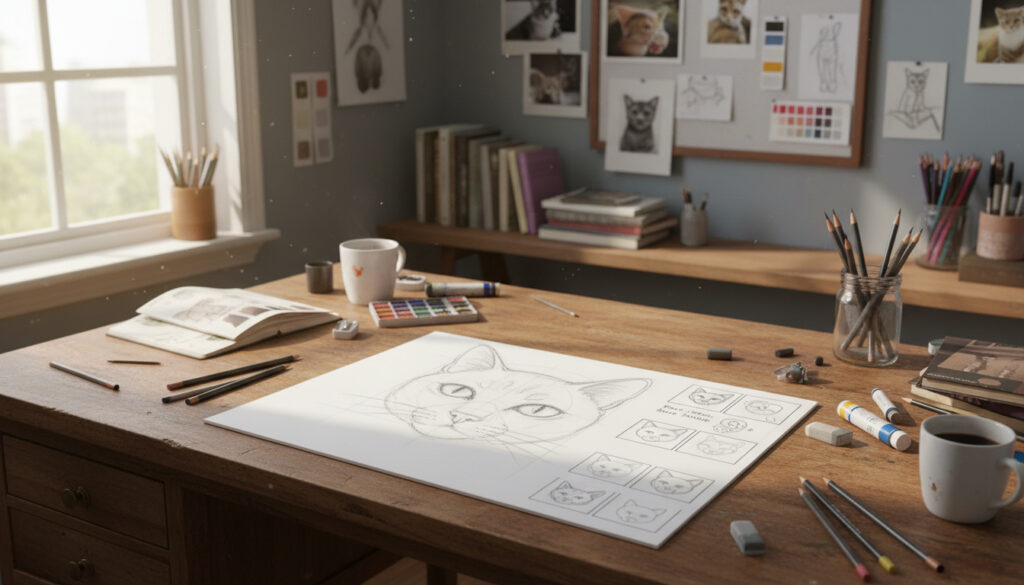
How to Draw a Cat – Master Simple Steps For Art
Learning how to draw a cat involves both creative freedom and structured technique. Whether aiming for a cartoon-style sketch or a realistic feline portrait, the essential steps develop core skills for artists at any level. Drawing a cat provides a versatile subject for practicing anatomy, proportions, and textural detail.
Cats, with their expressive features and graceful bodies, offer an ideal blend of challenge and accessibility for pencil and paper or digital art. Starting with simple shapes and layering details leads to a rewarding finished drawing. Multiple styles and approaches are available, making the process adaptable for beginners and those seeking more advanced results.
How do I start drawing a cat?
Beginner to Intermediate
30-60 minutes
Paper, pencils, eraser, optional shading tools
Realistic or cartoon
- Break the drawing process into simple, repeatable steps for clarity.
- Use appropriate materials to enhance comfort and outcome.
- Common pitfalls include disproportionate features; stepwise guidelines help prevent this.
- Explore both cartoon and realistic styles to understand differences.
- Lightly sketching initial shapes allows for easy correction.
- Adding small textural details brings drawings to life.
| Attribute | Details |
|---|---|
| Time Required | 30-60 minutes |
| Skill Level | Beginner friendly |
| Materials Needed | Paper, pencils, eraser, shading tools |
| Approach | Step-by-step illustration techniques |
| Styles | Cartoon or realistic options |
| Corrections | Begin with light lines for easy erasing |
What materials and techniques should I use?
Which tools are recommended for drawing a cat?
Basic tools include any quality drawing paper, standard or soft pencils for outlining and shading (such as a 6B pencil for dark areas), and a clean eraser. Sketching lightly with your pencil ensures that mistakes can be erased without damaging the paper, a recommendation echoed by several reputable tutorials (source).
How do I add shading and texture to make my cat drawing stand out?
Shading provides depth and realism, especially on the fur and facial features. Start by filling in a base color or value, and layer in shadows with a slightly darker pencil or, for digital artists, by adding clipped shadow layers. Short pencil lines create fur texture, and placing highlights along one side of the body can give dimension. Experts advise using dark gray—not black—for outlines and pupils, maintaining softness and detail (video reference).
For those using digital platforms, sketching on an initial layer, applying base colors beneath, and adding clipped layers for shadows is an efficient sequence. Traditional paper methods rely on careful erasing and gradual textural buildup. The fundamental process remains similar across mediums (digital and pencil tutorial).
What role does color play in cat drawing?
After finalizing the outline and main features, colored pencils or markers can be used to add patches, fur markings, and creative highlights. Vivid color combinations suit cartoon approaches, while subtle blends complement realistic sketches (Beginner Step-by-Step Cat Drawing Tutorials).
How can I improve and add style to my cat drawings?
What distinguishes a realistic cat drawing from a cartoon cat?
A realistic cat drawing relies on accurate anatomical proportions and detailed texturing—using reference photos and careful placement of ears, chin, and eyes (realistic technique video; cartoon approach).
Are there specific techniques for achieving lifelike fur?
Lifelike fur is achieved by layering short, outward pencil strokes, gradually shifting the length and darkness based on the cat’s anatomy. Cheeks and neck receive longer strokes, while the face stays softer and shorter. Adding fur overlays in darker tones increases depth (Techniques: Shading and Texturing).
Correct feature placement is vital. Ears typically sit on the top corners of the head, while the chin is centered on the lower edge. Eyes and nose should be outlined gently to adjust as needed throughout the process (drawing demonstration).
What steps can help beginners improve quickly?
Referring to photographs, practicing basic shapes, and experimenting with both cartoon and realistic styles are recommended strategies to build skill. Trying new patterns and color schemes after outlining the basic shape helps boost creativity and confidence in the finished piece (tutorial source).
What is the typical sequence for drawing a cat?
- Prepare your materials, arranging paper, pencils, eraser, and reference images (art guide).
- Start with basic shapes: circle for the head, oval for the body, smaller circle for the rear. Sketch lightly.
- Add defining features—ears, eyes, nose, legs, and tail—using gentle, curved lines for accuracy.
- Detail facial features, refine body outlines, and erase guidelines as needed.
- Layer in fur texture and add light shading to suggest depth and shadow (process demonstration).
- Complete with finishing touches and evaluate overall proportions, making corrections as necessary.
Which aspects of cat drawing are certain, and where do uncertainties remain?
| Established Knowledge | Unclear Details |
|---|---|
| Proportional steps for sketching cats are widely agreed upon in major tutorials. | Advanced shading and highly individualized artistic styles can differ among instructors. |
| Material recommendations are consistent (pencil, paper, eraser). | Techniques for achieving photo-level realism may not be universally taught. |
| Guidance on basic outlining and feature placement is standardized. | Blending and fur texturing methods vary depending on medium and artist. |
How have cat drawing methods evolved, and why focus on both traditional and digital techniques?
Cat drawing has long been a foundational exercise in art education, helping students understand form, proportion, and movement. Recently, digital tools have become common, allowing for easy edits, color exploration, and experimental layering. Traditional pencil drawing remains valued for its tactile process and direct control over lines and texture. Both methods provide unique advantages for learners and professionals.
For further exploration of innovative techniques, visit Expert Drawing Hub.
Which sources and expert perspectives inform this guide?
“Starting with basic shapes and moving steadily to details helps artists avoid common mistakes and build confidence in their drawings.” Art educator at Art Is Fun
“Simple, loose sketches are perfect for beginners or cartoon styles, while careful guidelines support more realistic portrayals.” Procreate cat tutorial
More detailed analyses can be found at Industry Insights.
What are the key takeaways from step-by-step cat drawing tutorials?
Learning how to draw a cat is accessible for beginners and adaptable for those hoping to refine technique or explore style. Resources such as Beginner Step-by-Step Cat Drawing Tutorials provide comprehensive guidance from initial sketches to detailed finishing touches.
Frequently Asked Questions
How long does it typically take to draw a cat?
Can these techniques be adapted for drawing other animals?
What are some common mistakes to avoid when drawing a cat?
Is it necessary to include shading in a basic cat drawing?
How do digital cat drawings differ from traditional pencil sketches?
Where can I find structured beginner tutorials on cat drawing?
What features are most important for capturing a cat’s expression?
Can I create both cartoon and realistic cats using the same process?
Is it necessary to use reference photos?
What simple patterns can be used in cartoon cat drawings?
More related posts
 Order New Driving License – UK DVLA Steps Costs and Times
 Temp Cover Car Insurance – Costs Coverage Guide 2025
 Train Sim World 5: Free Pack, Platforms & Difficulty
 DVLA Swansea Contact Number – Official Phone Details
 Six by Nico Edinburgh: Menu Prices, Dress Code & Controversy Explained
 Kids Shoe Size Chart – UK EU CM Toddler Guide
 Chuck Norris Death: Verified Facts, Cause, and Legacy at 86
 28 Years Later Reviews: Worth It? RT, Guardian, IMDb