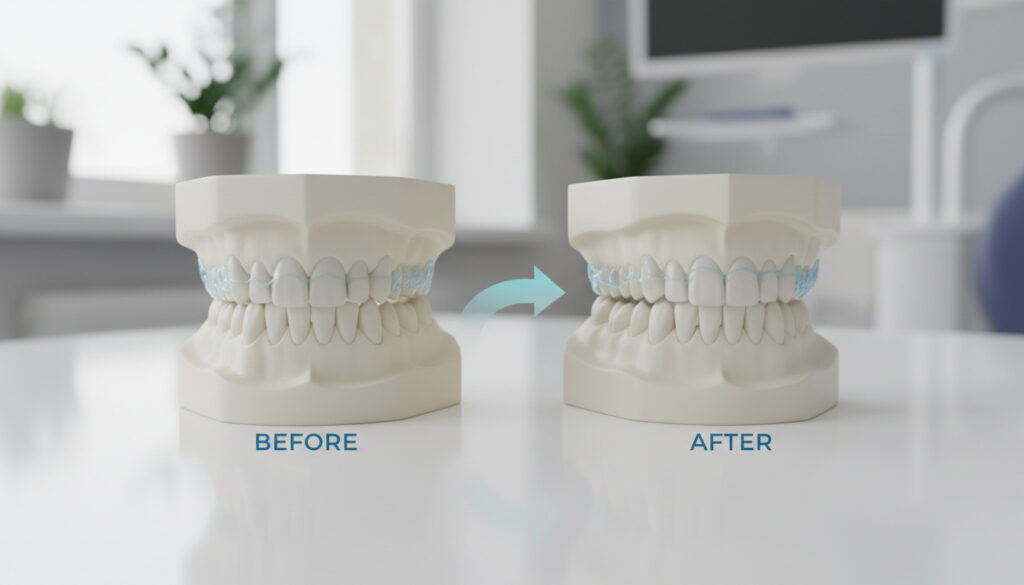
Invisalign Before and After – Real Timelines and Results
Invisalign clear aligners have repositioned millions of teeth worldwide, offering a removable alternative to fixed metal braces. Clinical documentation indicates that while comprehensive treatment typically requires 12 to 18 months, patients often observe measurable alignment improvements within the first six months of consistent wear.
The transformation process relies on custom-manufactured clear plastic trays that apply calibrated pressure to specific teeth. Real patient records demonstrate that outcomes vary significantly based on initial dental complexity, biological response rates, and adherence to daily wear protocols.
Examining verified case studies reveals distinct patterns in how quickly different malocclusions resolve and which factors consistently predict whether someone completes treatment in six months versus requiring extended protocols.
What Do Invisalign Before and After Results Look Like?
- Aligners generate gentle, consistent pressure that gradually shifts teeth into ideal positions without brackets or wires.
- Six-month milestones commonly reveal straighter anterior teeth, partial gap closure, and widening of crowded dental arches.
- Treatment compliance represents the single most critical variable in achieving projected completion dates.
- Patients with minor spacing or slight crowding typically achieve results significantly faster than those presenting bite discrepancies.
- Three-dimensional digital scanning creates precise pre-treatment maps documenting crowding, rotations, and back teeth relationships.
- Biological response rates vary; some individuals experience faster tooth movement due to bone density and metabolic factors.
| Milestone | Typical Visible Change | Documentation Type |
|---|---|---|
| Initial Consultation | 3D digital scan captures baseline | Diagnostic records |
| 2-3 Months | Subtle initial shifts | Rarely photographed |
| 6 Months | Straighter teeth, reduced crowding, gap closure initiated | Common milestone photography |
| 9 Months | Significant alignment progress, arch form established | Mid-treatment comparison |
| 12-14 Months | Near-final positioning, bite refinement | Late-stage documentation |
| 18+ Months | Complex case completion | Full transformation series |
Invisalign Results Timeline: Before and After Progress
Three to Six Months
At the six-month mark, most patients observe noticeable improvements in tooth alignment. Clinical records document common visible changes including straighter anterior teeth, opening of previously crowded areas, partial closure of diastemas, and development of a wider, more uniform dental arch. These modifications often reach thresholds where friends and family detect differences, providing psychological momentum for continued compliance.
Simpler cases involving minor incisor crowding or small interdental gaps occasionally resolve completely within this window. One documented case involved straightening upper and lower front teeth to satisfactory completion in six months, while another patient corrected uneven smile aesthetics with crowded incisors utilizing 14 aligners over 28 weeks.
Orthodontic monitoring identifies consistent aligner wear of 20 to 22 hours daily as the single most important factor in maintaining treatment timelines. Patients adhering to this protocol typically achieve projected results within expected timeframes or slightly faster.
One Year and Beyond
The average Invisalign case requires approximately 12 to 18 months for full completion. Treatment documentation confirms that complex presentations—significant bite problems, severe crowding, or extensive misalignment—necessarily extend beyond average timelines to ensure teeth move safely into final positions.
One patient record demonstrated straightening of crowded front teeth using 18 aligners over nine months. Conversely, another case featuring deep bite combined with misaligned and crowded teeth required the full extended protocol for comprehensive resolution.
How Treatment Works Mechanically
Each set of custom-manufactured clear aligners is worn for approximately one to two weeks before progression to the subsequent set in the series. Each appliance applies targeted pressure designed to achieve specific incremental tooth movements. The sequence continues until the 3D-planned final occlusion is achieved.
Does Invisalign Really Work? Real Before and After Proof
Documented Patient Transformations
YouTube documentation from creator Emma Sandy captures an 18-month Invisalign journey through three daily photographs compiled into a time-lapse sequence. The visualization tracks specific changes in bottom tooth positioning, dental midline alignment, and maxillary anterior arrangement across 500+ days of treatment.
Official case studies feature Rebecca R., a 41-year-old patient from Boise, Idaho, who completed 14 months of treatment to correct crossbite, crowding, and bite alignment issues. Post-treatment records indicate increased on-camera confidence following the dental rehabilitation.
Rebecca R.’s 14-month treatment totaled $3,930. After $1,500 in insurance coverage, the patient responsibility equaled $135 monthly during the active treatment phase.
Clinical Photography Evidence
Dental practice archives display corrections of upper and lower arch crowding, resolution of overlapping central incisors, and realignment of crowded mandibular incisors. These photographic records demonstrate the system’s capacity to address varied malocclusion types without bracket bonding.
Invisalign Before and After for Adults and Teens
Adult Treatment Outcomes
Adult patients constitute a significant portion of documented Invisalign successes. The 41-year-old patient from Boise represents a typical demographic profile, presenting with crossbite and crowding that developed without childhood intervention. Adult bone metabolism, while slower than adolescent growth, permits effective tooth movement when proper force levels are applied through sequential aligners.
Age-Related Considerations
Available research focuses primarily on adult patient populations. Specific comparative data regarding teen versus adult treatment efficiency remains limited in current documentation. Providers typically assess skeletal maturity, third molar status, and compliance capacity when determining candidacy across age groups.
Patients presenting deep bite, severe rotational crowding, or skeletal discrepancies require extended treatment timelines beyond standard averages. These cases demand precise force application over longer durations to achieve stable periodontal outcomes.
The Invisalign Treatment Sequence
- Initial Consultation: Three-dimensional digital scanning creates precise maps of bite relationships, documenting crowding, spacing, rotations, and posterior tooth fit.
- Fabrication: Laboratory manufacturing produces the custom aligner series based on computerized treatment planning.
- Initiation: Patient receives initial aligner sets with instructions for 20-22 hour daily wear and hygiene protocols.
- Three-Month Evaluation: Clinical assessment verifies tracking against predicted tooth positions.
- Six-Month Milestone: Photographic documentation typically captures visible aesthetic improvements and arch development.
- Completion: Final aligners achieve planned occlusion; retention protocols commence immediately.
Established Facts vs. Individual Variables
| Established Information | Information That Remains Variable |
|---|---|
| Average treatment requires 12-18 months for full correction | Precise prediction of individual tooth movement rates |
| Aligners require 20-22 hours daily wear for efficacy | Long-term retention stability beyond five-year studies |
| Simple crowding cases resolve in approximately 6 months | Success rates for severe skeletal Class II/III discrepancies |
| 3D digital scanning precedes all documented treatment | Comparative outcomes between teen and adult populations |
How Invisalign Fits into Modern Orthodontics
Clear aligner therapy represents a shift from fixed appliance mechanics to removable, computer-guided force delivery. The technology accommodates adult professionals seeking aesthetic treatment options without ceramic brackets or metal wiring. Integration of digital scanning has largely replaced conventional polyvinyl siloxane impressions in practices offering this modality.
The system occupies a specific niche between cosmetic dentistry and comprehensive orthodontics, effectively treating mild to moderate misalignment while referring complex surgical cases to traditional fixed appliances. Those seeking detailed candidacy information should review Invisalign Treatment Results, Timeline, and Effectiveness data.
Documented Patient Experiences
“I took three photos every day for 500 days to document my 18-month Invisalign journey, creating a time-lapse showing how my bottom teeth, midline, and top teeth changed throughout treatment.”
— Emma Sandy, patient documentarian
“After 14 months correcting my crossbite and crowding, I feel more confident on camera and in professional settings. The total investment was $3,930, with my insurance covering $1,500.”
— Rebecca R., 41, Boise, Idaho
Key Takeaways on Invisalign Transformations
Verified patient documentation confirms that Invisalign produces measurable aesthetic and functional improvements within 2 to 6 months for most wearers, with comprehensive treatment averaging 12 to 18 months depending on initial complexity. Success correlates directly with wearing aligners 20 to 22 hours daily. Those considering treatment should schedule a consultation to determine their specific timeline through Invisalign Treatment Results, Timeline, and Effectiveness assessment.
Common Questions
Can you see Invisalign results in 3 months?
Initial subtle shifts may be detectable by the patient, but visible aesthetic changes typically require 2 to 6 months depending on case complexity and biological response rates.
What is the Invisalign success rate?
Clinical documentation emphasizes compliance as the primary success determinant rather than publishing specific percentage rates. Patients wearing aligners 20-22 hours daily typically achieve projected outcomes.
How effective is Invisalign for adults?
Adult patients, including a documented 41-year-old with crossbite and crowding, achieve successful outcomes in 12-18 months, though treatment may proceed slower than in adolescent patients due to metabolic differences.
How much does Invisalign cost?
Documented cases show total treatment costs around $3,930 for 14-month protocols, with insurance coverage reducing patient responsibility to approximately $135 monthly in specific instances.
What happens after Invisalign treatment ends?
Retention protocols commence immediately following final aligner wear to prevent orthodontic relapse, though specific long-term retention data beyond initial stabilization periods remains limited in current research.
More related posts
 Cost of Living Crisis UK 2025: Is It Still Ongoing?
 S25 Ultra Release Date – Price, Specs and Availability
 Sea Life Centre Birmingham – Tickets Prices Opening Times
 Fantastic Four First Steps: Flop, Lore & Streaming
 John Lewis Customer Service – Fast, Reliable, Expert Support
 Miller and Carter Menu with Prices 2025 – Fixed Lunch & Steaks
 When Do Babies Start Teething – Timeline, Signs and Symptoms
 Best Savings Account UK – Highest Rates Compared 2025